Charged black holes with triple horizons emerge from a regularized electric
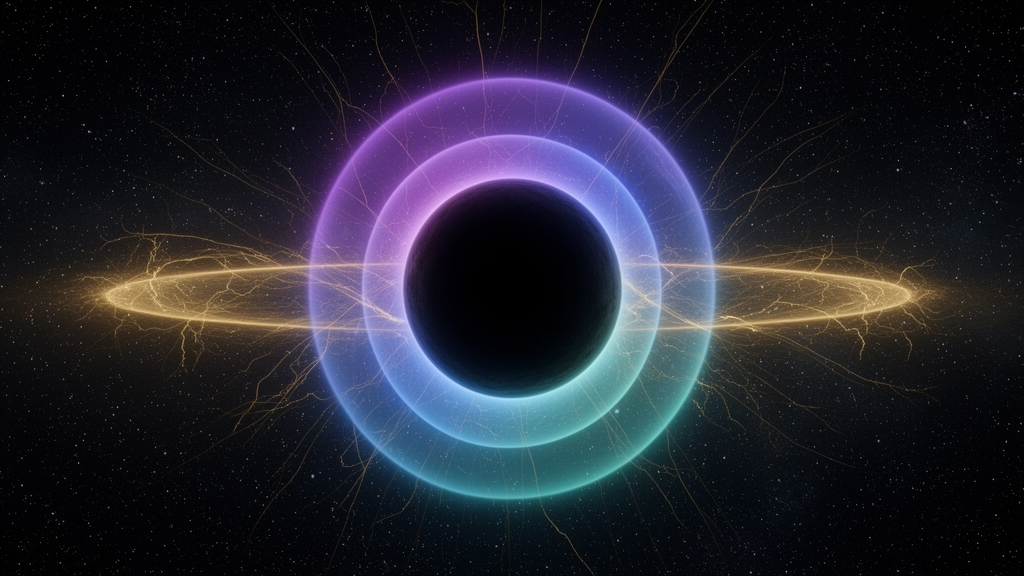
A theoretical study published in The European Physical Journal C explores charged black hole solutions in Einstein gravity coupled to a nonlinear electrodynamics model built from a regularized electric potential. The approach regularizes the potential of a point charge as φ = Q / √(r0^2 + r^2), yielding an electric field that remains finite everywhere and reduces to Maxwell’s form at large distances, while adding nonlinear corrections near the origin. In the coupled spacetime, the solutions depend on three parameters: ADM mass M, electric charge Q, and a nonlinear scale r0. The paper analyzes causal structure and thermodynamics and finds the model can produce black holes with single, double-degenerate, and even triple-degenerate ultra-extremal horizons, alongside naked singularities, depending on dimensionless ratios m = M/r0 and q = Q/r0.
 xCruzo