Banking AI Explainability Is Now a Regulatory Requirement -- Are Banks Ready?
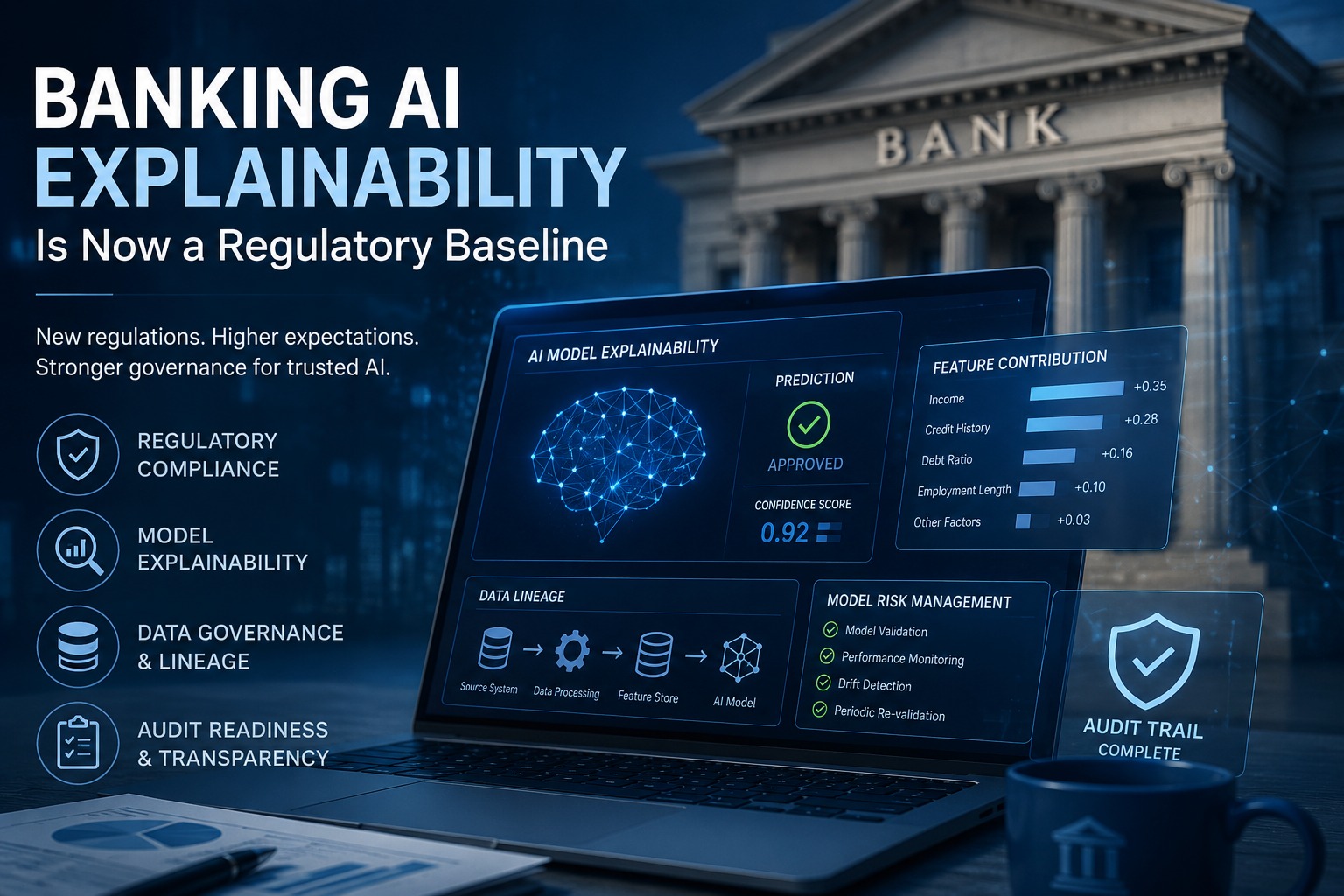
Regulators have turned AI explainability into a concrete regulatory baseline for banking, reshaping risk management and how banks demonstrate accountability. A 2026 Wolters Kluwer survey of 148 financial institutions found that 28.4 percent cite explainability as their top AI regulatory concern. The US and EU are reinforcing this shift with interagency guidance that elevates model risk management from a curiosity to a mandatory, ongoing process. The guidance, SR 26-2 from the Federal Reserve and related OCC Bulletin 2026-13, requires continuous monitoring, drift detection, periodic revalidation, and lifecycle governance for material quantitative models. Generative AI and agentic AI are explicitly carved out from that framework because regulators view them as novel and rapidly evolving. Banks must devise parallel governance for GenAI while authorities finalize regulatory positions. SR 11-7 remains relevant, reinforcing the three core elements—model development and use, validation, and governance—even as supervisory expectations tighten. The practical effect is a higher regulatory floor for conventional models, while the immediate governance for newer AI technologies remains under active discussion.