Additive manufacturing of superelastic NiTi braided metamaterials: an innovative strategy for engineering minimally invasive vascular medical devices - npj Metamaterials
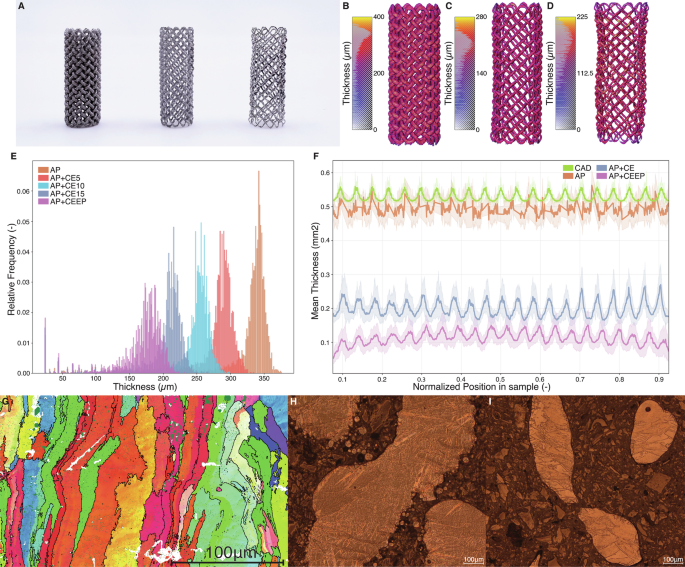
Researchers report an additive-manufacturing approach for NiTi braided vascular medical devices that aims to combine the flexibility of braided architectures with NiTi’s superelasticity. The method uses computational design and optimized printing and postprocessing to overcome the typically lower compliance seen in printed superelastic alloys, enabling mechanical properties that can be spatially tuned. By integrating modeling with additive constraints, the team optimized braided geometries for cardiovascular use. They then assessed manufacturability and mechanical performance of cylindrical lattice and braided tubular structures, including printability evaluations and crimping characterization. Multiple proof-of-concept demonstrations are presented, alongside analysis of current limitations and future research directions for additively made vascular implants.
 xCruzo