Photoreceptor replacement: a disease-agnostic approach for the treatment of advanced retinal degeneration - Eye
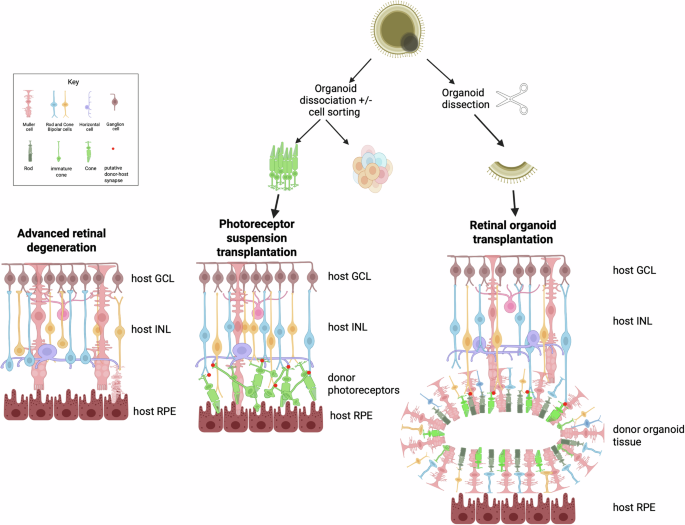
The study review discusses a disease-agnostic approach for treating advanced retinal degeneration using photoreceptor replacement strategies. It notes that recent work increasingly focuses on models where most or all host photoreceptors are absent, reducing confounding from material transfer during experiments. Earlier studies used sheets of human fetal retina or rodent retina, and more recent efforts include grafts from mouse or human pluripotent stem cell–derived retinal organoids, which have shown promising improvements in function. The article says rods dominate many transplanted grafts, while cone-rich organoids have been generated for macula-directed therapies but have not yet been trialed for transplantation. It also highlights limitations in confirming donor-host synaptic connectivity, because degeneration alters inner-retinal neurons and standard assays based on proximity of fluorescent markers can be only indicative. The review references work by Mandai and colleagues that used genetic modification to prevent production of bipolar cells in donor tissue to help achieve donor-host connectivity.
 xCruzo