Ancient terrestrial forests reborn as modern marine ecosystems under shifting sea levels
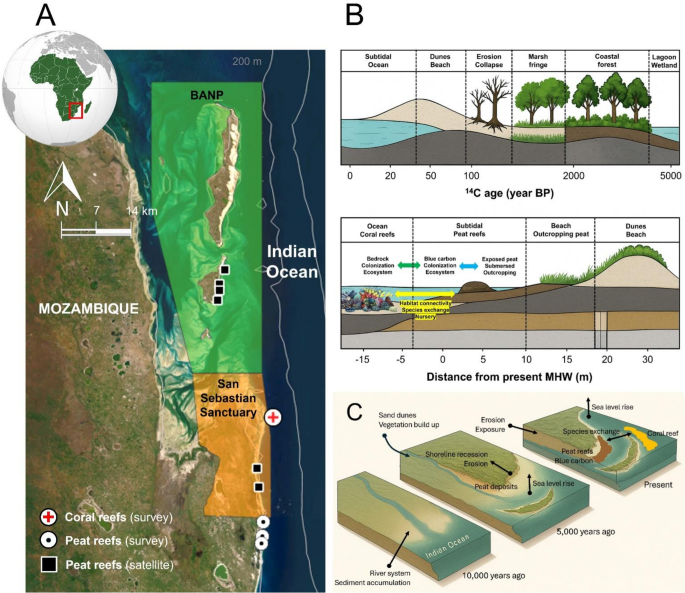
Researchers describe “tropical peat reefs” as a new kind of habitat that can function alongside coral reefs as sea levels shift. Comparative field analyses show distinct structure and ecology: in the Bazaruto Archipelago, coral reefs are dominated by scleractinian coral framework, while peat reefs consist of consolidated relict peat substrate with macroalgae and seagrass patches, often with markedly lower or absent live hard coral cover. Invertebrates show the strongest differences, with statistically significant habitat effects (PERMANOVA/ANOSIM, p < 0.01) and separate clustering in multivariate ordinations. Coral-associated invertebrates were more common on coral reefs, while peat reefs supported more detritivores and algal grazers. Small reef fish and mobile fauna displayed more overlap, likely due to mobility, and the study reports at least 41 shared small reef fish species and 44 shared megafauna species.
 xCruzo