
Volvo XC90
Midsize luxury three-row SUV · 2002–present. 39,492 units sold in the US in 2024
How it began
Volvo Car Corporation, in Gothenburg, Sweden. Project director Hans Wikman led the program, which Volvo president Tuve Johannesson signed off on at the Arizona Proving Ground in May 1999. The winning design was led by Doug Frasher at Volvo's concept center in Camarillo, California. A reference group of people from different backgrounds, including actress Maud Adams, pushed for a masculine but not 'macho' look. The second generation (2014) was the first Volvo on the SPA architecture, presented under Peter Mertens, senior vice president of research and development.
Design work took place between Gothenburg and California. Swedish first-generation production at Torslanda reached 636,143 cars on July 11, 2014; the last went to the Volvo Museum. CKD assembly also took place in Thailand and Malaysia, and in 2014 Volvo announced that the outgoing model would continue in Daqing, China, as the China-market XC Classic. The company has other plants in Ghent, Belgium, and China. Its Ridgeville plant near Charleston, South Carolina, already builds the electric EX90; the October 2026 release forecasts adding the XC60 in 2027. The facility has received over $1.3 billion and has capacity for up to 150,000 cars a year; that announcement does not move the current XC90 to the U.S.
It debuted on January 7, 2002 at the Detroit auto show, with 15,000 dealer orders before sales began as a 2003 model. The second generation was revealed in Stockholm in August 2014 and its U.S. online store opened September 3, 2014; it arrived as a 2016 model.
XC belongs to Volvo’s Cross Country family: the V70 XC appeared in 1997, and with the XC90 in 2002 the wagon was renamed XC70. Volvo compared the new XC90 with the XC70 and describes it as its hybrid flagship. This family history does not assign a specific literal meaning to the number 90.
In the late 1990s demand for SUVs was booming, especially in the United States, and Volvo had none. Critics said it was arriving late. Volvo bet on fixing the problems of the SUVs of the day, above all rollover risk, and on fitting seven seats into about 480 cm with a flat cargo floor and car-like handling. Volvo planned on 50,000 units a year; in 2005 it sold 86,000.
Generation by generation
- Gen. 12003–2014 · P28 (plataforma P2)
Volvo's first SUV, designed not to roll over
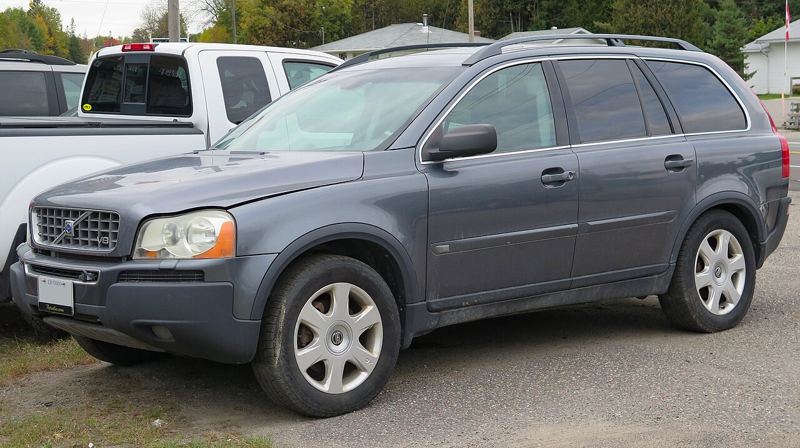
Photo: Elise240SX · CC BY-SA 4.0 What changed. It was Volvo’s first SUV, offering up to seven seats, about 480 cm of length, a 286 cm wheelbase, a flat cargo floor and electronically controlled all-wheel-drive versions. The international transverse inline-five and inline-six range spanned 2.4 to 3.2 liters: the 2.4-liter diesel made 163 hp and the 2.9-liter T6 made a published international 272 hp. The 3.2-liter six arrived later, for the 2007 model year. Volvo introduced a transverse aluminum 4.4-liter V8 internationally in 2004, rated at 315 metric hp (311 SAE), with a six-speed automatic; U.S. documentation dates its arrival in that market to 2005. Volvo reported more than 110 international awards.
The innovation. Roll Stability Control (RSC), a world first: a gyro sensor measures roll speed and roll angle, and if it detects rollover risk it cuts power and brakes wheels. It came with inflatable curtains for all three rows, pretensioners on every belt, an integrated child booster seat and a low front crossmember to 'engage' the crumple zones of smaller cars. In 2002 Volvo rolled an XC90 three times in front of the press in Gothenburg and the roof stayed largely intact.
If you buy one usedCheck fuel-pump flange campaign 09V483 on specified 2003–2005 XC90s with listed hot-climate sale/registration conditions. Selected other examples include belt attachments 03V391, outer tie rods 06V155 and winter wiper-arm slippage 06V144 on specified 2003 vehicles; starter-terminal clearance 05V529 on specified 2005 cars; power-steering pipes 11V286 on 2010–2011; and fuel-line campaign 10V147 on specified 2010 cars. Each has its own inspection, adjustment or replacement procedure. Confirm current VIN eligibility and completed repairs with Volvo. - Gen. 22016–present · SPA
The touchscreen, Thor's Hammer and the first plug-in hybrid
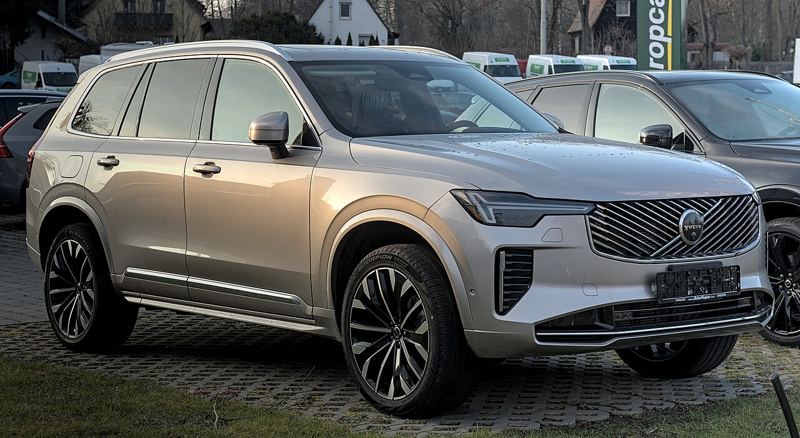
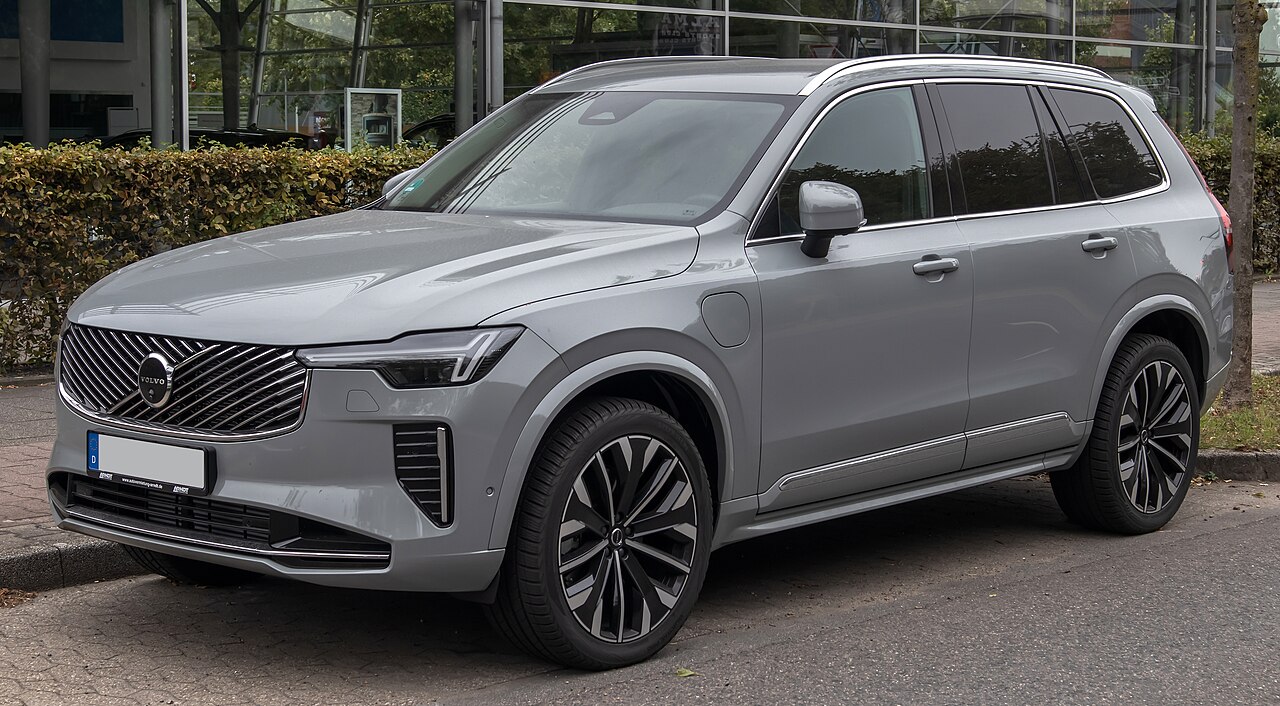
Photo: Alexander Migl · CC BY-SA 4.0 What changed. The first Volvo on the Scalable Product Architecture. Goodbye to five, six and eight cylinders: every Drive-E engine is a 2.0-liter four with an eight-speed automatic; in the U.S. the supercharged and turbocharged T6 AWD made 316 hp. A tablet-like portrait touchscreen replaced almost every button, the 'Thor's Hammer' headlights debuted, as did an optional 1,400 W Bowers & Wilkins sound system. The global 2020-model refresh introduced B-badged 48-volt powertrains; B5 and B6 reached the U.S. range for the 2023 model year. Another refresh was announced in September 2024, with a new front end, an 11.2-inch screen and more insulation. For U.S. model years 2021 through 2024, the plug-in version was called XC90 Recharge.
The innovation. The T8 Twin Engine, the first plug-in hybrid XC90: a supercharged and turbocharged 2.0 up front plus an 80 hp electric motor on the rear axle, 400 hp and 640 Nm combined and about 40 km of electric range (2014 European cycle). It also introduced two safety firsts: run-off-road protection (it tightens the belts and absorbs energy in the seats) and automatic braking at intersections.
If you buy one usedSelected campaigns include 2016 side-airbag wiring 15V342, third-row curtain clearance 15V497, sunroof autoclose software 16V268 and coolant bleeder hoses 19V308; 2016–2017 A/C drains 16V690 and passenger belt-buckle studs 16V798; 2019–2022 steering gears 23V001; 2020–2021 hydraulic brake units 21V716; and second-row belt bolts 23V827. For affected unrepaired 2020–2022 PHEVs under 25V179, do not charge until the software/conditional battery-module repair is complete. Certain 2020–2026 PHEVs also have brake campaign 25V392: NHTSA’s July 2025 urgent notice advises not driving and disabling B-mode regenerative braking until recall software is installed. Camera campaign 25V908 requires new work even after 25V282 on specified 2023–2025 cars. IIHS lists the 2025–2026 XC90 as TOP SAFETY PICK+; its Plug-in Hybrid award explicitly requires manufacture after December 2024. Individual ratings also have variant/build conditions. Confirm the actual VIN, current instructions and each completed remedy with Volvo.
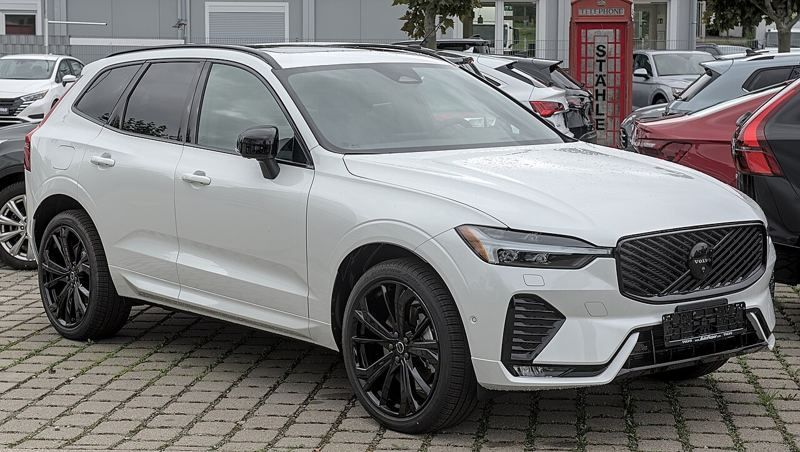 Volvo XC602010–present
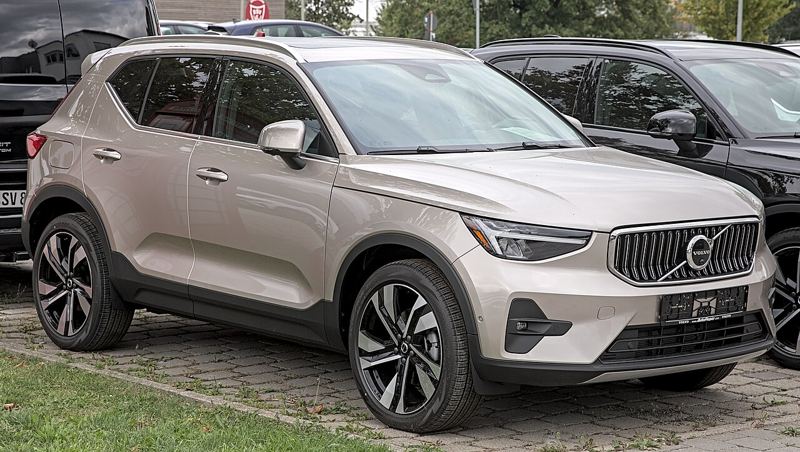 Volvo XC402019–present
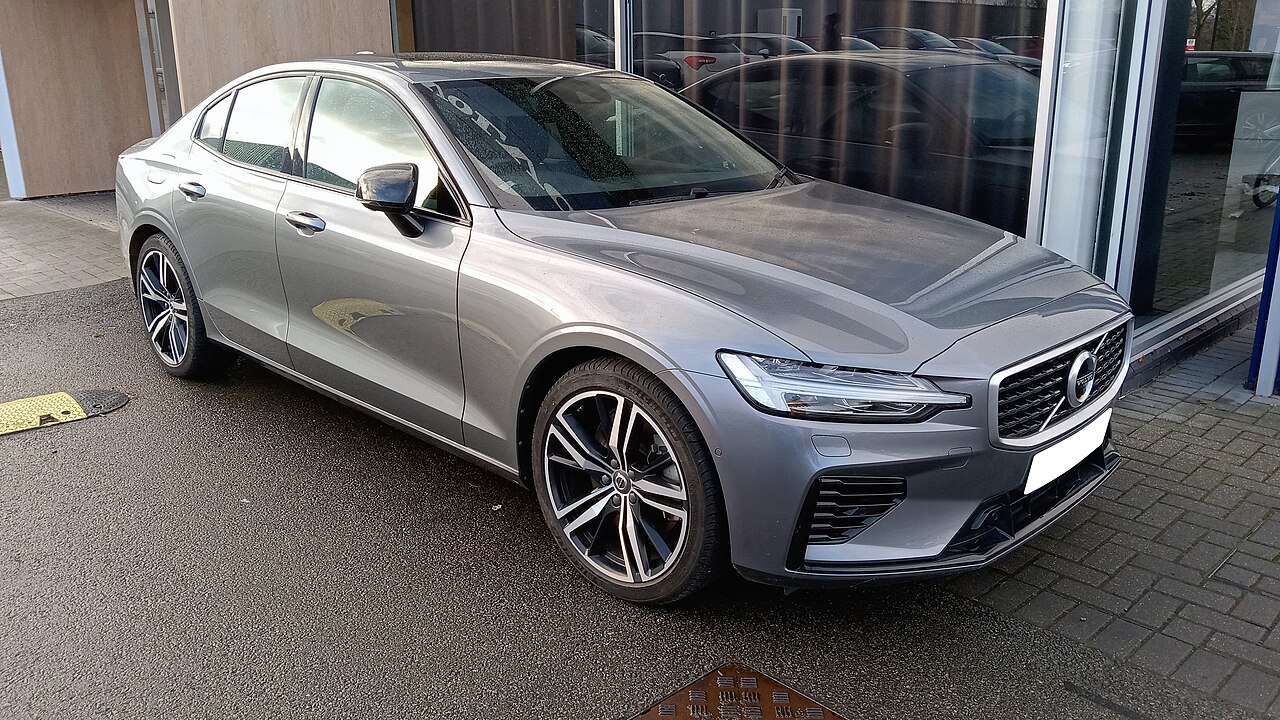 Volvo S602001–2025
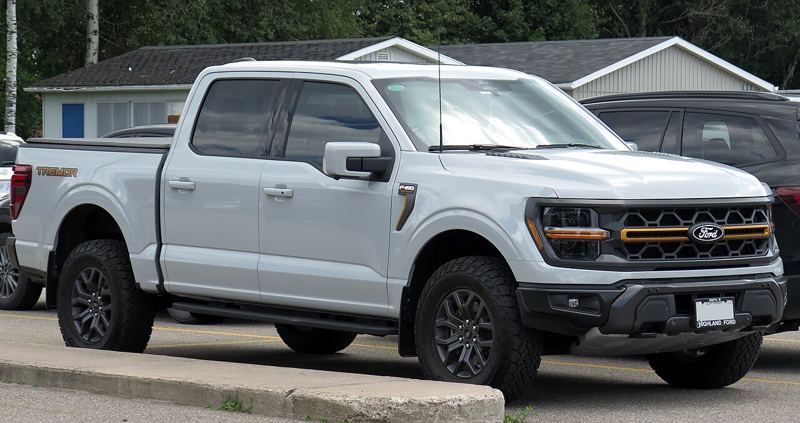 Ford F-Series (F-150)1948–present
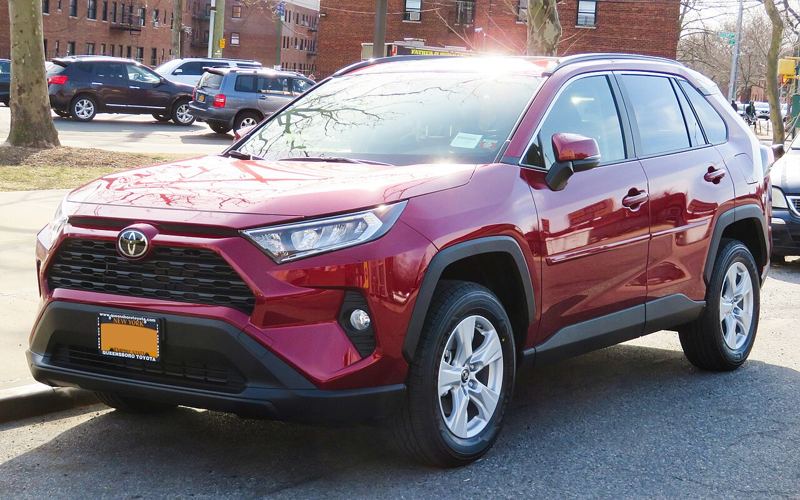 Toyota RAV41994–present (US from 1996)
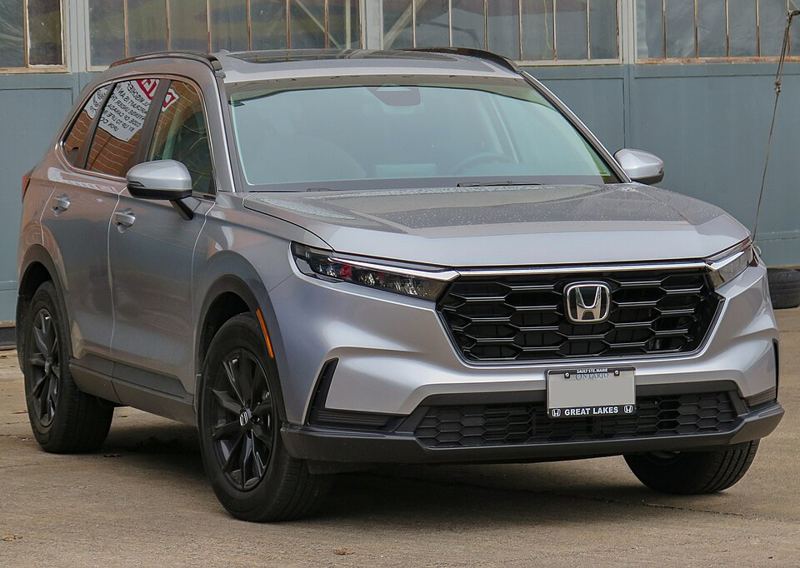 Honda CR-V1995–present
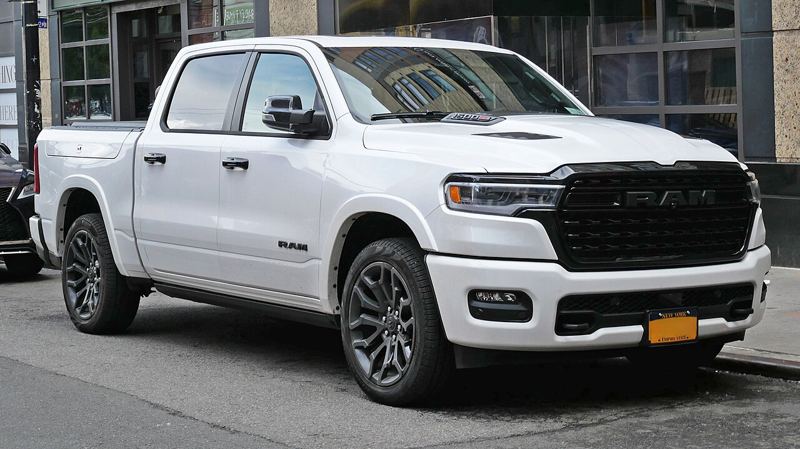 Ram 15001981–present
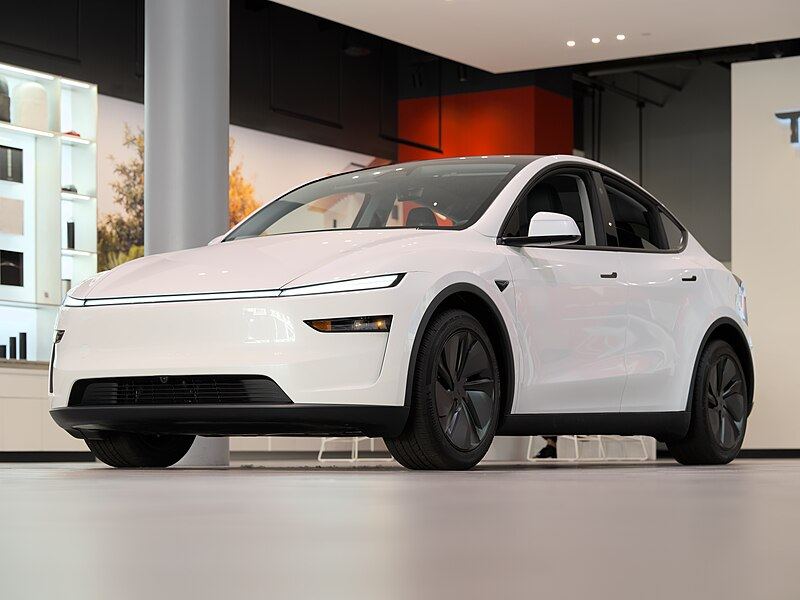 Tesla Model Y2020–present
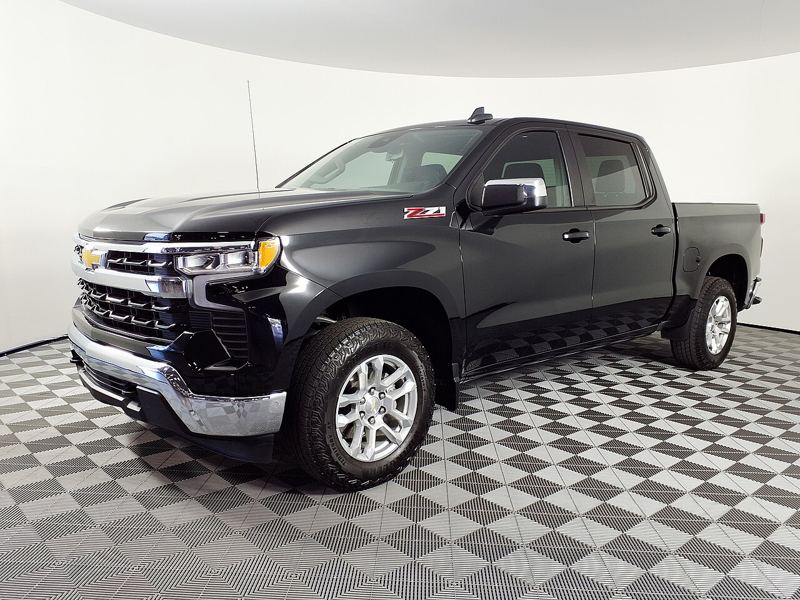 Chevrolet Silverado1999–present


