
Kia Sorento
Midsize three-row SUV · 2003–present. 95,154 units sold in the US in 2024
How it began
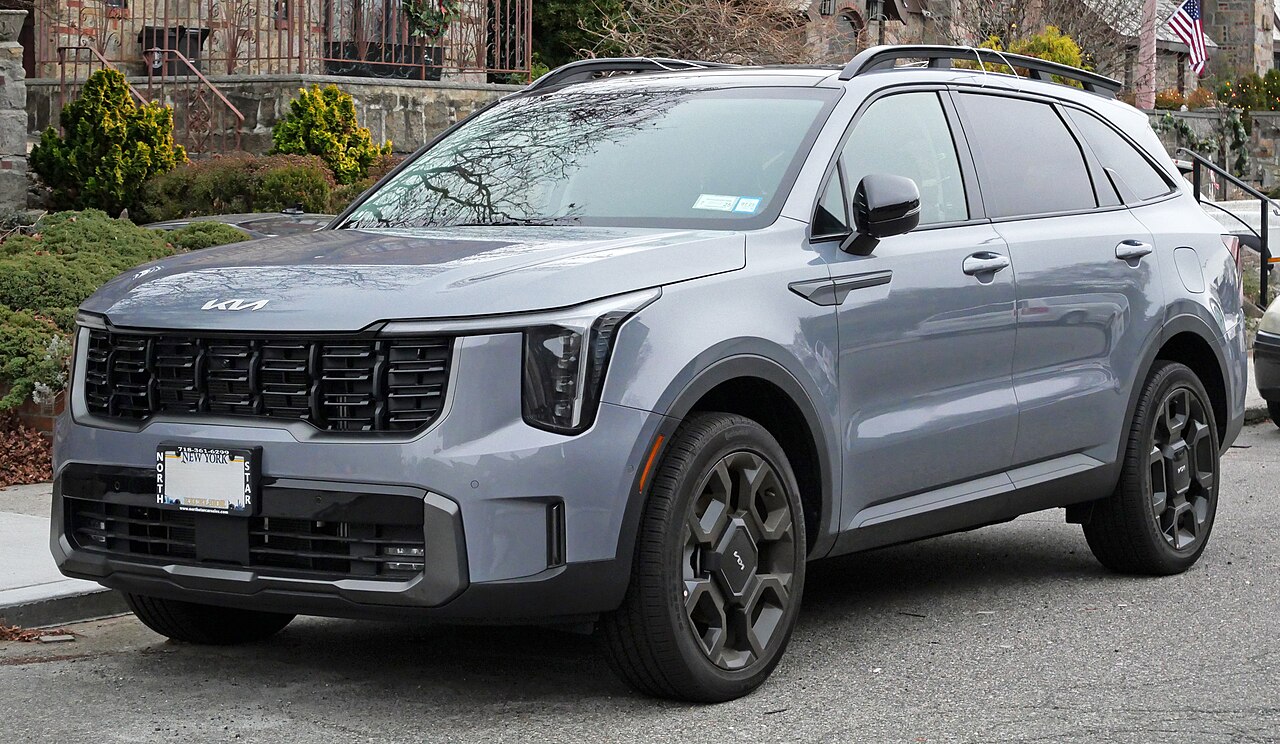
Kia Motors, part of the Hyundai group since 1998, created the Sorento as its first large SUV. The releases reviewed do not identify an individual designer or chief engineer for the first generation. The second generation was styled by a global team led by Peter Schreyer, Kia's chief design officer; the third came from a collaboration between Kia's studios in Namyang (Korea), Frankfurt (Germany) and Irvine (California); and the fourth was designed inside and out at Kia's Irvine studio.
The first generation reached the United States as an import from South Korea, and Kia also positioned it for Europe. Since November 16, 2009, the Sorento has been built at Kia Motors Manufacturing Georgia in West Point, Georgia: it was the first Kia built in the United States and the plant's first vehicle. Today the gasoline Sorento is still assembled there; the Hybrid and Plug-in Hybrid are not on Kia's list of models assembled in the U.S.
It debuted on March 7, 2002, at the Geneva Motor Show. In the United States it arrived as a 2003 model, priced from $19,995 (LX 2WD) to $24,595 (EX 4x4).
As reported at its Geneva debut, the name draws on Sorrento, the town in southern Italy, for the design's Mediterranean feel, and also on Sorrento Valley, the San Diego area full of high-tech companies. Kia spells it with a single r.
In the early 2000s Kia wanted to enter the midsize SUV market with a luxurious, advanced vehicle, the first of a new range of models. It took what it had learned from the small Sportage and scaled it up to midsize, with a truck-style ladder frame and four-wheel drive with a low range. Kia describes it as combining SUV-grade safety with passenger-car comfort, and as the model that became the benchmark for all its SUVs. In Kia's own words, it marked a huge step forward for the brand.
Generation by generation
- Gen. 12003–2009 · BL
The body-on-frame SUV that moved Kia up a level
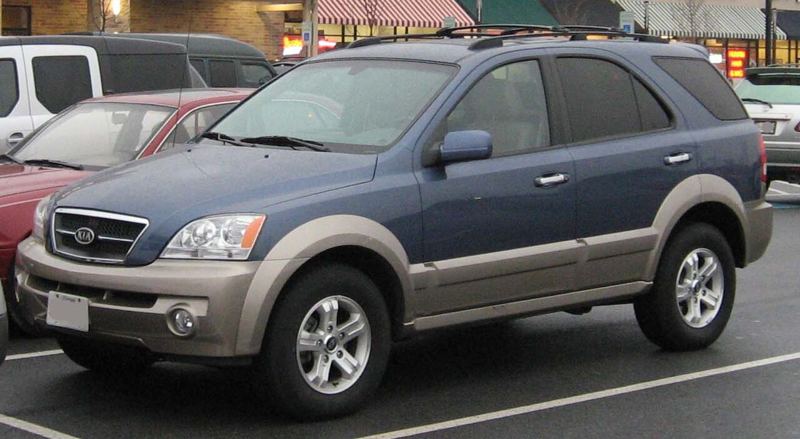
Photo: IFCAR · Public domain What changed. It was Kia's first midsize SUV. While rivals like the Honda Pilot and Toyota Highlander used car-type unibodies, the Sorento rode on a truck-style ladder frame, with a 3.5-liter V6 making 192 hp and 217 lb-ft, the same engine as the Sedona minivan. For the 2007 model year it got an all-aluminum 3.8-liter V6 with 262 hp (36 percent more), a five-speed automatic and a 5,000-lb towing rating.
The innovation. Real four-wheel drive in a family SUV: the LX 4x4 had a part-time, shift-on-the-fly system and the EX 4x4 a full-time Torque-On-Demand transfer case, both with a low range for rough terrain. From the 2007 model year it also came standard with stability control, curtain airbags and a driver's knee airbag.
If you buy one usedNHTSA lists for the 2003 model fuel tubes that could leak near the tank because they rubbed against the floor panel (05V353). On 2006–2007 models the brake-light switch could fail, leaving the lights off or on and keeping the shifter stuck in Park (09V130); another switch campaign covered 2007–2011 (13V114). On 2007–2008 units built from June 2006 to November 2007, the passenger airbag could switch off with an adult in the seat (11V473), and on 2007–2009 models moisture could enter the ABS module and cause a short (20V088). All are repaired free; look up the VIN at NHTSA.gov. The U.S. model used the 3.5-liter V6 through 2006 and introduced the 3.8 for 2007; later years also offered a 3.3-liter V6. For older campaigns, request manufacturer/dealer records too, since the standard VIN tool may omit recalls more than 15 years old. - Gen. 22011–2015 · XM
The first Kia built in the United States
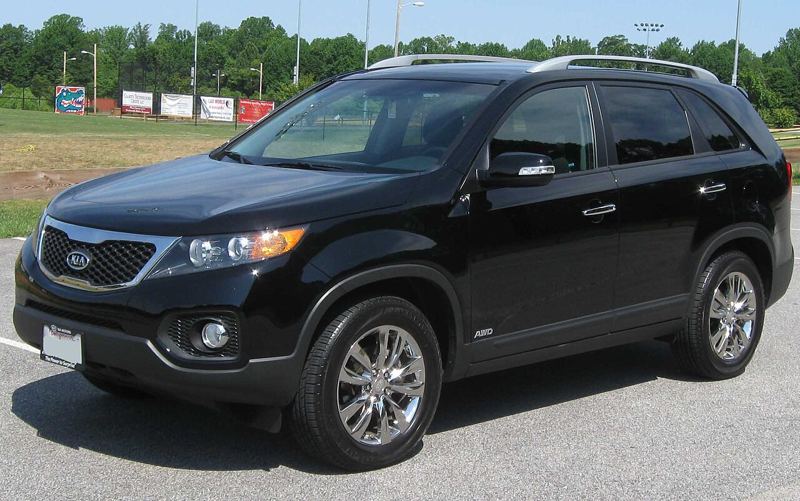
Photo: IFCAR · Public domain What changed. It moved from a truck frame to a crossover unibody, with up to seven seats and almost five more cubic feet of cargo space. Its design, based on the 2007 KND-4 concept, came from Peter Schreyer's team. It offered a 175 hp 2.4-liter four and a 276 hp 3.5-liter V6, with front- or all-wheel drive. It went on sale in January 2010 as a 2011 model, built in Georgia. The 2014 refresh changed about 80 percent of the parts and brought a stiffer chassis and a 290 hp direct-injection 3.3-liter V6.
The innovation. It debuted a six-speed automatic designed and built by Kia itself, and the first panoramic sunroof on any Kia. The hood was designed to crumple and flex to reduce injuries to pedestrians and cyclists. The 2014 refresh brought Blind Spot Detection, the first available on a Kia.
If you buy one usedThis generation has major engine campaigns. NHTSA lists machining errors that could wear the engine bearings on 2012–2014 models (17V224, inspection and engine replacement if needed); engine-compartment fire risk on 2012–2013 (20V750) and 2011 (23V877), with knock sensor detection software (KSDS) and engine replacement as needed; and possible fuel pipe leaks on units that received a replacement engine, 2012–2017 (18V907). On 2011–2014 models the brake hydraulic electronic control unit (HECU) could short and catch fire, parked or driving (23V652); on 2014–2015 brake fluid could leak inside that unit (20V519 and 21V331). In both cases NHTSA advises parking outside, away from structures, until repaired. Campaign 21V331 supersedes 20V519; confirm that the later remedy is complete. Ask for the exact VIN and recall-repair history before buying. - Gen. 32016–2020 · UM
Bigger, stronger and turbocharged
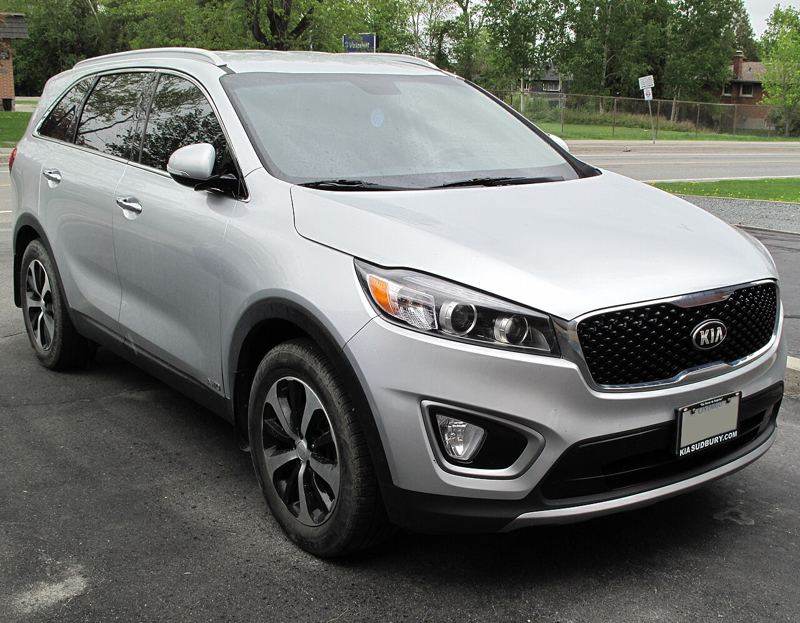
Photo: Elise240SX · CC BY-SA 4.0 What changed. Its U.S. wheelbase grew 3.1 inches, from 106.3 to 109.4; length increased from about 184.4–184.6 to 187.4 inches, with more room in all three rows. Its design came from Korea, Germany and California, and it made its North American debut at the Los Angeles Auto Show in November 2014. It offered three engines: a 185 hp 2.4-liter, a new 240 hp, 260 lb-ft 2.0-liter turbo, and the 290 hp, 252 lb-ft 3.3-liter V6. In May 2017 the one-millionth U.S.-built Sorento rolled out of West Point.
The innovation. A much stronger body: it doubled the amount of ultra-high-strength and hot-stamped steel. And the 2.0-liter turbo delivered more torque than the V6 from a smaller engine.
If you buy one usedNHTSA lists several campaigns for certain 2016 vehicles from distinct production lots: an accelerator pedal with a bad solder joint that could prevent acceleration (15V089), the passenger seat belt buckle (15V446), a rear suspension weld (16V480), the driver seatback welds (16V770) and a shift lever that might not lock (22V612). On 2016–2022 units with a Kia tow hitch, the harness module could short and catch fire; park outside away from structures until repaired (22V703). For 2017 models with the 3.3 V6, the crankshaft may have been improperly heat treated (17V586); for 2018, a curtain airbag part that could detach (17V784) and a weld on the steering column crossbar (18V656); for 2019, water could leak into the rearview camera (23V639). All have a free repair. - Gen. 42021–present · MQ4
Designed in California, and finally a hybrid
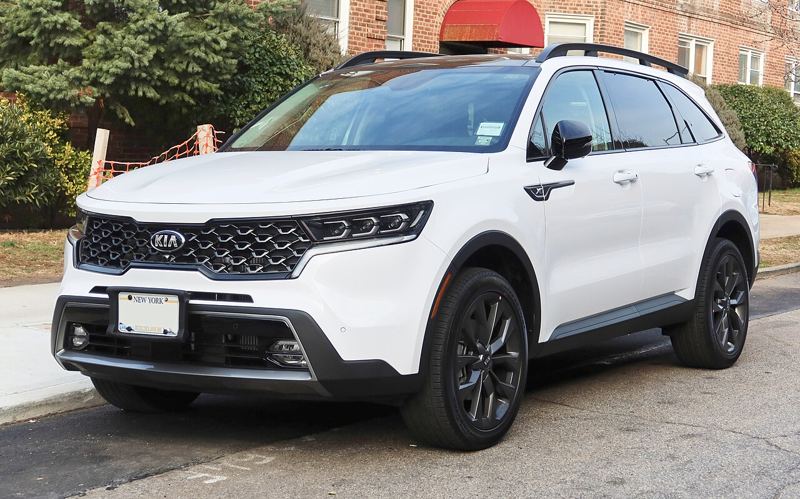
Photo: Kevauto · CC BY-SA 4.0 What changed. Kia launched it in the U.S. on September 22, 2020, as a 2021 model, designed at its Irvine studio, with a tiger-nose grille in the style of the Telluride. The base engine was a 191 hp 2.5-liter, with an optional 281 hp, 311 lb-ft 2.5 turbo and an eight-speed dual-clutch automatic, the most torque of any Kia SUV at the time. The X-Line adds an inch of ground clearance, and second-row captain's chairs were offered for the first time. The 2024 refresh brought the X-Pro with BFGoodrich all-terrain tires, a 4,500-lb towing rating and dual 12.3-inch curved screens.
The innovation. The first electrified Sorentos. The Hybrid pairs a 1.6-liter turbo with a 44 kW electric motor and a 1.5 kWh battery for 227 hp; Kia estimated 37 mpg combined, one more than the Toyota Highlander Hybrid. The all-wheel-drive Plug-in Hybrid, with a 67 kW motor and a 13.8 kWh battery, makes 261 hp and about 30 electric miles by Kia's 2020 estimate.
If you buy one usedNHTSA lists for 2021 models with the 2.5 turbo a possible fuel leak between the high-pressure pump and the fuel rail (21V519); for 2022, a turbo oil supply pipe that could crack (22V202); for 2021–2022, a transmission oil pump fault that could cause a complete loss of drive power (22V760, transmission inspection or replacement plus software); and for 2021–2023, an HVAC blower motor harness that could cause a fire (25V649, letters mailed January 2026). For 2024, the power steering wiring harness may have been assembled incorrectly (24V287); for 2024–2025, a software error could shut off the low beams and taillights (25V006); and for 2025, improperly tightened connecting rod bolts (25V548). Look up the VIN at NHTSA.gov. The 2025 model earned IIHS Top Safety Pick under the 2024 award criteria. The updated moderate-overlap test was Marginal, including Marginal rear-passenger restraints/kinematics; individual injury subscores differ. This tested rating applies to vehicles built after July 2024 and before October 2025.
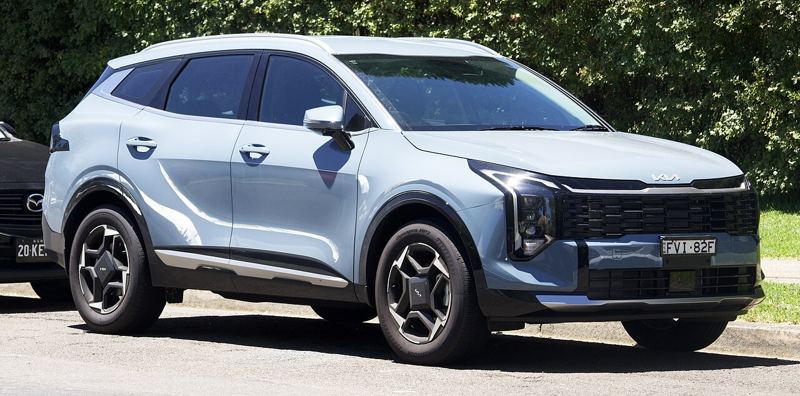 Kia Sportage1993–present
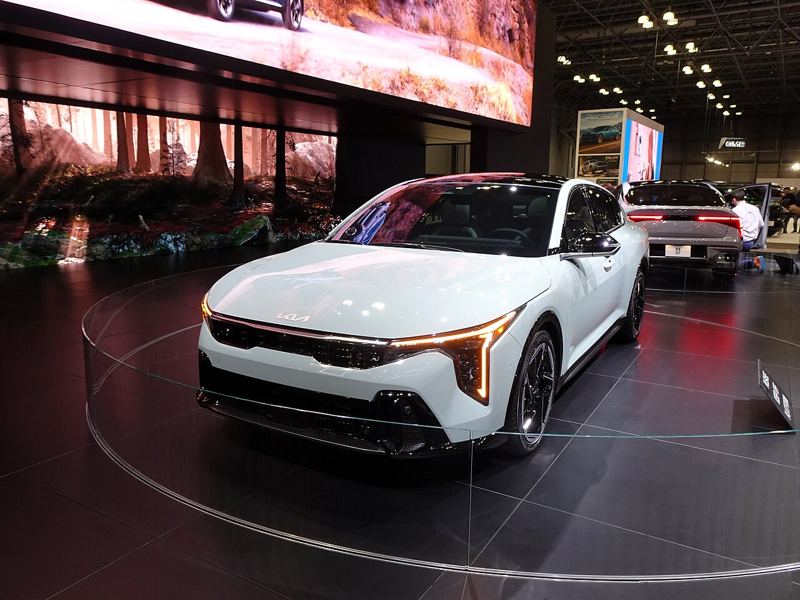 Kia K4 (Forte)2000–present
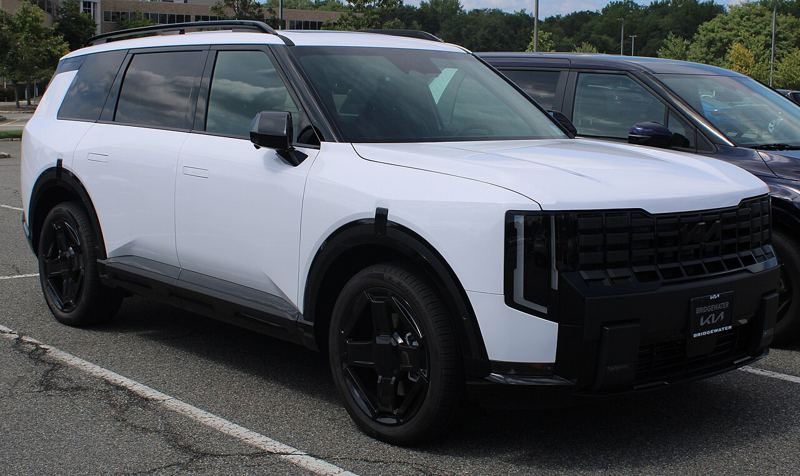 Kia Telluride2020–present
 Kia Seltos2019–present
 Ford F-Series (F-150)1948–present
 Toyota RAV41994–present (US from 1996)
 Honda CR-V1995–present
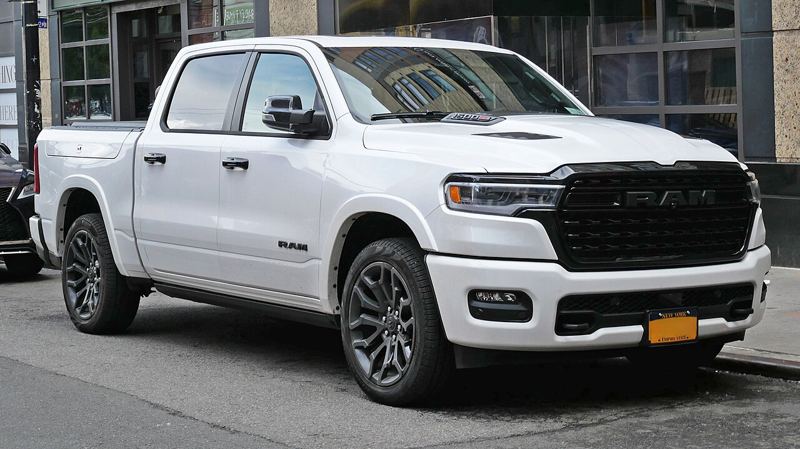 Ram 15001981–present
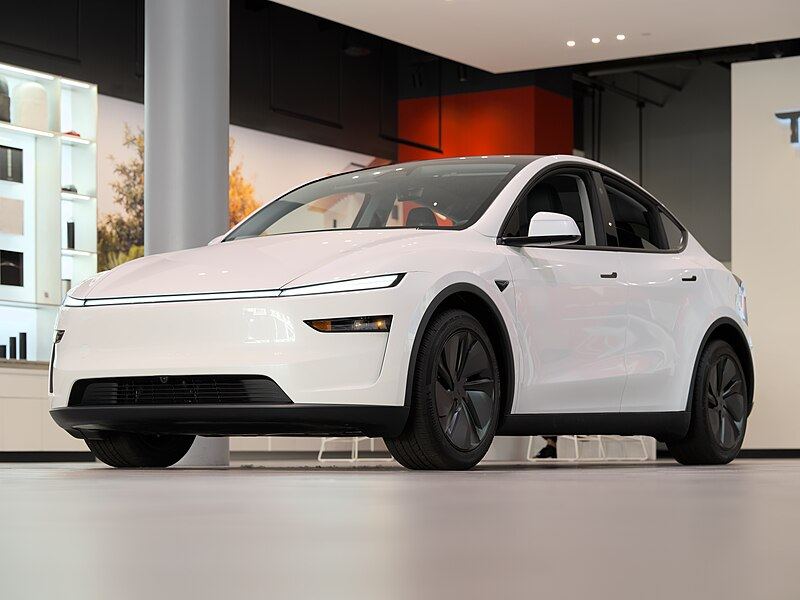 Tesla Model Y2020–present


