
Mitsubishi Mirage
Subcompact car · 1985–2002 and 2014–2024. 29,766 units sold in the US in 2024
How it began
Mitsubishi Motors Corporation created the Mirage. The company was established in Japan in April 1970 from Mitsubishi Heavy Industries’ automotive business. Mitsubishi Motors North America handled the modern U.S. introduction; its 2013 president and CEO was Yoichi Yokozawa. In a 2015 WardsAuto interview, executive vice president Don Swearingen recalled internal disagreement over importing the car, while senior product-strategy manager Bryan Arnett said sales exceeded expectations.
The original Mirage-derived U.S. imports were built in Japan. NHTSA’s manufacturer-submitted MY1989 hatchback pattern identifies Mizushima, the Mitsubishi plant in Kurashiki, Okayama prefecture. This partial model record identifies an assembly location rather than every individual VIN. The modern Mirage began production at Mitsubishi Motors Thailand’s third Laem Chabang factory in 2012; Mitsubishi then described the campus as its largest plant and export hub outside Japan. Official MY2024 assembly-country records still identify Thailand for the U.S. hatchback and G4.
Mitsubishi launched Mirage in Japan in March 1978. It reached the U.S. as the MY1979 Dodge Colt and Plymouth Champ; Mitsubishi’s own Mirage-badged U.S. brochure followed for MY1985. The earlier retail series ended after MY2002, with rental-fleet supply continuing in 2003 as Lancer replaced it in public sales. MMNA announced the returning MY2014 Mirage’s $12,995 starting price on August 19, 2013. U.S.-market production ended in late 2024 and there was no MY2025.
Mirage means the optical illusion, including a desert mirage. Mitsubishi’s original model history explicitly traces the name to the French word and also mentions mystical and romantic senses. Its 1993 U.S. brochure states that the Mirage trademark was used with the consent of Grand Touring Cars, Inc., of Scottsdale, Arizona.
After the 1973 oil crisis, Mitsubishi wanted a car designed from the start to use as little fuel as possible. The result was its first two-box car with a front engine and front-wheel drive. In 2012 the name returned on a global compact built for many markets, and in the U.S. it found a very specific buyer: people who planned to buy a used car and discovered they could afford a new one.
Generation by generation
- Gen. 11979–…
Mitsubishi's first front-wheel-drive car
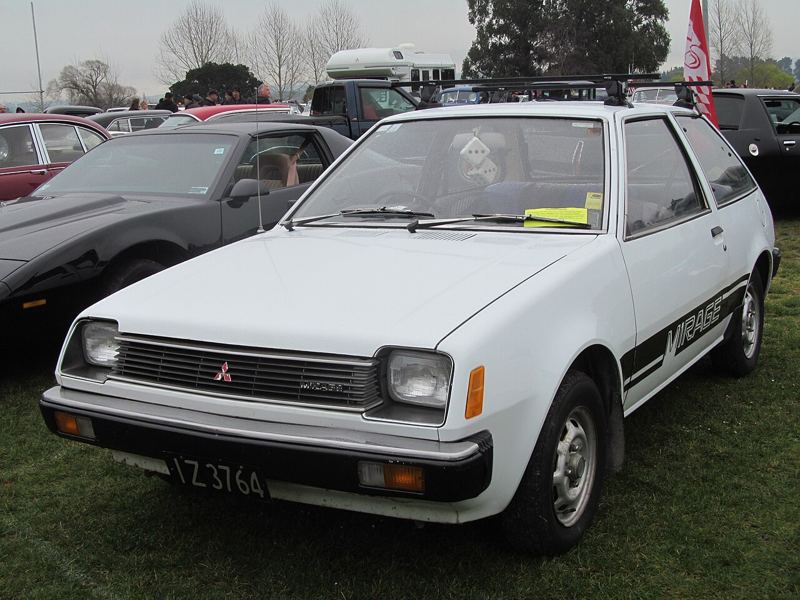
Photo: NZ Car Freak · CC BY 2.0 What changed. Mitsubishi launched its first front-engine, front-wheel-drive car in Japan in 1978. Original U.S. advertising identifies the MY1979 Dodge Colt and Plymouth Champ as Mitsubishi-built hatchbacks sold through Chrysler. The original Champ brochure lists independent suspension, power front disc brakes, rack-and-pinion steering and 1.4- or 1.6-liter four-cylinder engines. Its two-lever Twin-Stick offered POWER and ECONOMY ranges for the four-speed manual.
The innovation. The Twin-Stick gearbox (Super Shift to Mitsubishi): a second lever gave each of the four gears a high and a low range, so the manual effectively had eight forward speeds.
If you buy one usedIt was sold in the U.S. with Dodge and Plymouth badges, so look up its history under those names. The exact Mitsubishi/Mirage queries for model years 1979–1984 each returned zero campaigns on November 3, 2026; this does not resolve Dodge/Plymouth badges or the exact vehicle’s repair history. It is a collector car more than 40 years old: check for rust, Twin-Stick gearbox parts and, on the GTS, the condition of the turbo. - Gen. 21985–1988
The Mitsubishi-badged Mirage is born
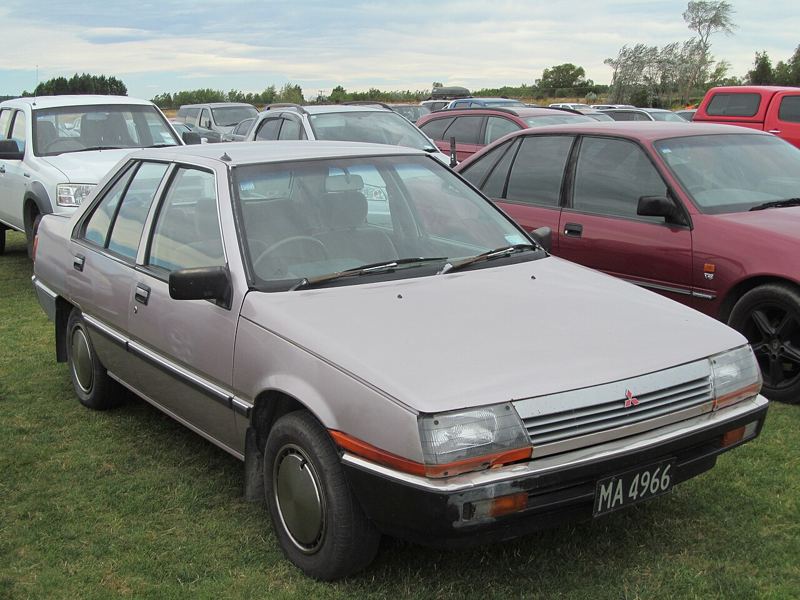
Photo: Riley from Christchurch, New Zealand · CC BY 2.0 What changed. The second global generation launched in Japan in October 1983. Mitsubishi’s U.S. MY1985 brochure offered the Mirage as a three-door hatchback, while official U.S. model records also retain Dodge and Plymouth Colts. The manufacturer’s global history describes three- and five-door hatchbacks and a four-door sedan, with several engines including a sporty 1.6-liter turbo. The earlier Mirage II already offered a sedan in Japan in 1982.
The innovation. A small turbo model under Mitsubishi’s own badge: the original MY1985 U.S. brochure includes a Mirage Turbo, and the manufacturer’s second-generation history confirms a 1.6-liter turbo option. Body styles and engines varied by market.
If you buy one usedNHTSA lists recall 95V103 (1986–1991): the red front seat-belt release buttons can break, and the pieces can jam the buckle. Confirm the fix was done. Given its age, confirm parts availability and the actual condition of the individual vehicle before buying. - Gen. 31989–1992
Fuel injection, twin cams and a 135-hp turbo
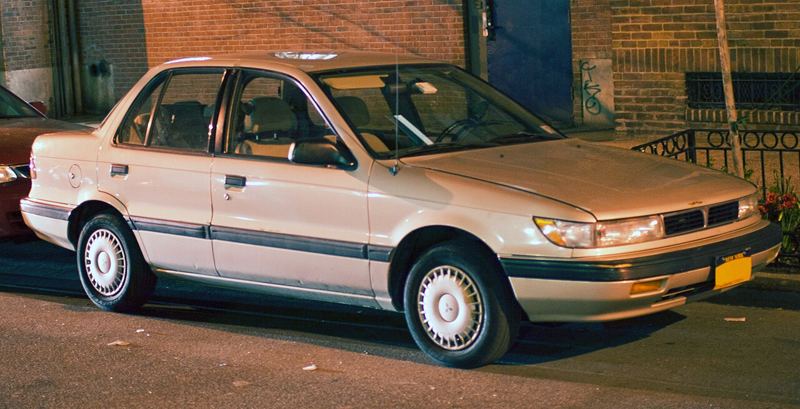
Photo: Mr.choppers · CC BY-SA 3.0 What changed. The U.S. MY1989 redesign offered hatchback and sedan bodywork alongside related Dodge/Plymouth Colt and Eagle Summit models. The 1.5-liter used multipoint fuel injection; Consumer Guide lists 81 hp for MY1990 and the later 123 hp twin-cam 1.6-liter GS sedan for MY1991. An original August 1989 Car and Driver road test documents the 135 hp 1.6-liter turbo hatchback.
The innovation. From 1991 the 1.5-liter moved to three valves per cylinder and rose to 92 hp, and sedans got a four-speed overdrive automatic in place of the three-speed.
If you buy one usedNHTSA recalls: 95V103 (front seat-belt buttons, 1989–1991) and 97V063 (1992–1993: excess lubricant can deform the door switch so the automatic shoulder-belt anchorage does not move properly). Problems documented by Consumer Guide: intake-valve deposits causing stumbling at startup (1990), front spring squeaks, and idle vibration on automatics from a poorly mounted radiator. - Gen. 41993–1996
Coupe, sedan and airbags
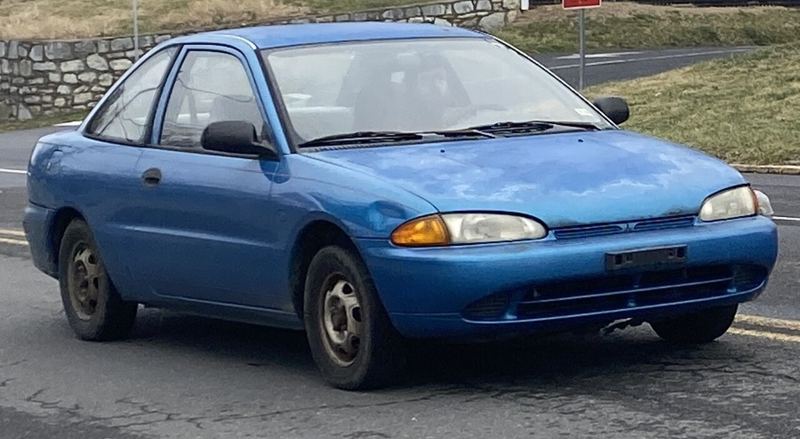
Photo: Cutlass · CC0 What changed. For MY1993 a two-door notchback coupe replaced the U.S. hatchback, alongside a four-door sedan built in Japan. The original manufacturer brochure gives 92 hp for the 1.5-liter and 113 hp for the 1.8-liter LS sedan; Consumer Guide also identifies the 1.8-liter ES sedan. Engine availability depended on body style and year: the LS coupe gained the larger engine for MY1994. Eagle Summit and Dodge/Plymouth Colt were related models during this period.
The innovation. Safety moved fast in three years: in 1993 the LS sedan offered antilock brakes, in 1994 the driver airbag arrived, and in 1995 the passenger airbag, which retired the awkward motorized shoulder belts.
If you buy one used1993 NHTSA recalls: 97V073 (driver automatic-belt guide) and 97V063 (door switch). ABS was dropped for 1994. Consumer Guide documents fuel starvation from clogged in-tank filters (1993–1995) and a misadjusted park/neutral switch that can prevent starting in Park/Neutral or permit starting in Drive (1993–1994). If you want a passenger airbag, choose a 1995 or 1996. - Gen. 51997–2002
Small, quiet and with a gearbox that learns
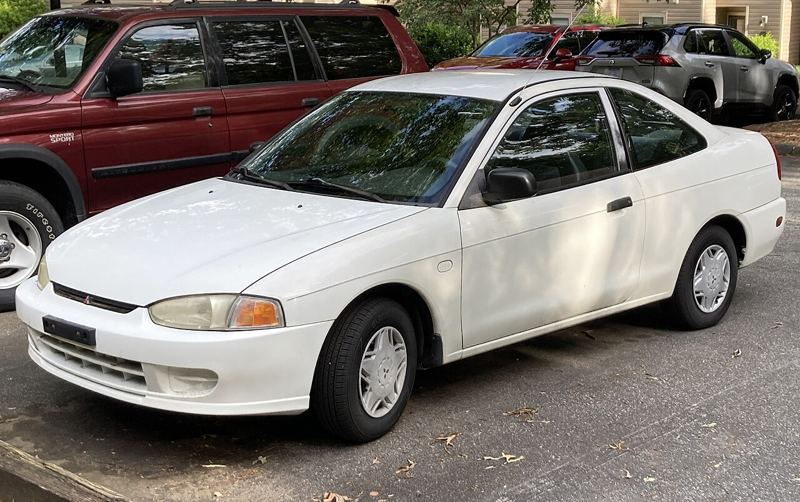
Photo: Sam Kennedy · CC BY-SA 4.0 What changed. The MY1997 redesign offered a coupe and sedan, the sedan with a three-inch-longer wheelbase. In its December 1996 road test, The Christian Science Monitor described a stiffer, more refined chassis and a notably quiet engine on the highway. The DE used a 92 hp 1.5-liter and the LS a 1.8-liter. Lancer replaced Mirage in public sales, while Consumer Guide records continued rental-fleet supply in 2003.
The innovation. A four-speed automatic that adjusted its shifts to recent throttle use. In 1996 The Christian Science Monitor called it the lowest-cost car with this kind of logic-controlled transmission.
If you buy one usedNHTSA recalls: 00V311 (certain 1997–1999 vehicles with the 1.5-liter engine) and 01V340 (certain 1999–2001 vehicles; confirm exact campaign and VIN eligibility): the crankshaft pulley bolt can loosen and, if the pulley falls off, power-steering assist is lost. 97V179 (1998): a poorly made brake-booster vacuum check valve. ABS was no longer offered from 2000. Consumer Guide documents spark plugs fouling on short cold-weather trips (1997–1998). - Gen. 62014–2024
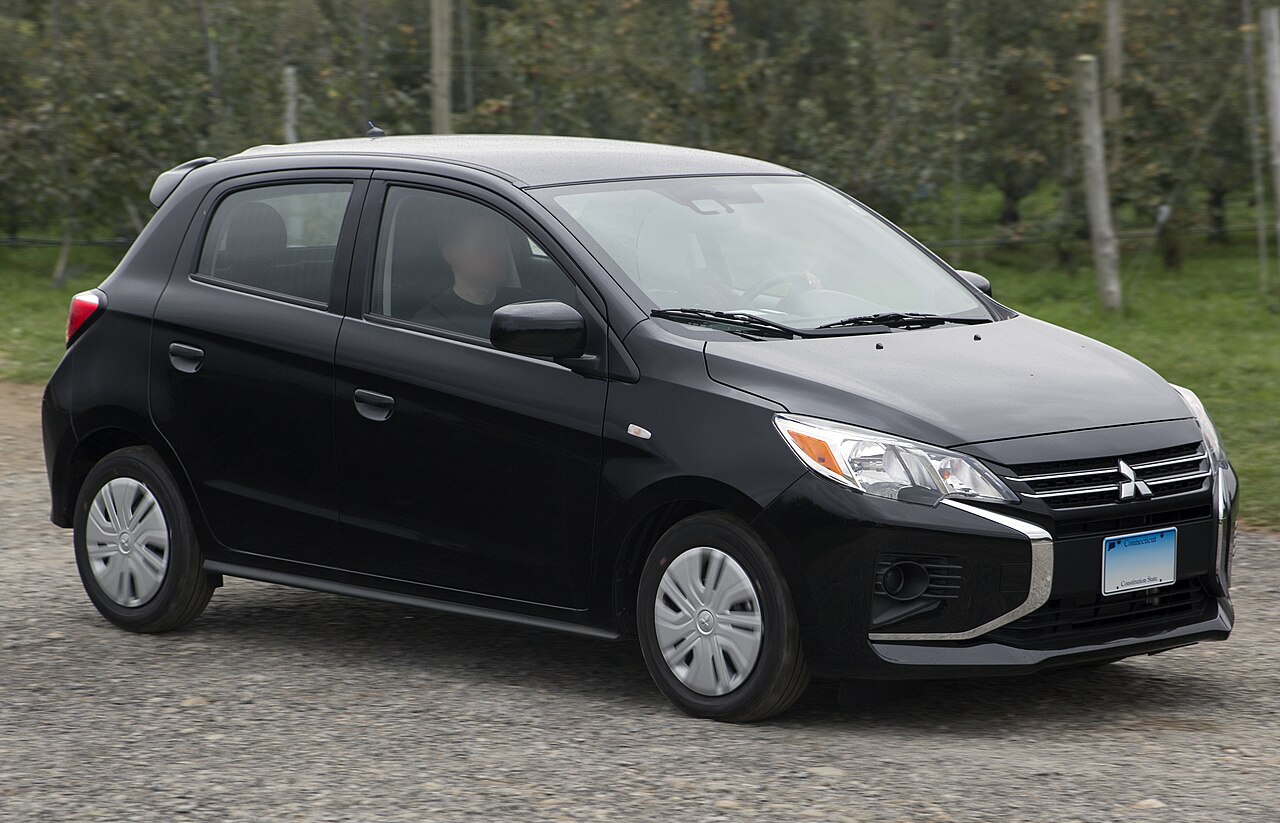
The comeback: three cylinders and 40 mpg
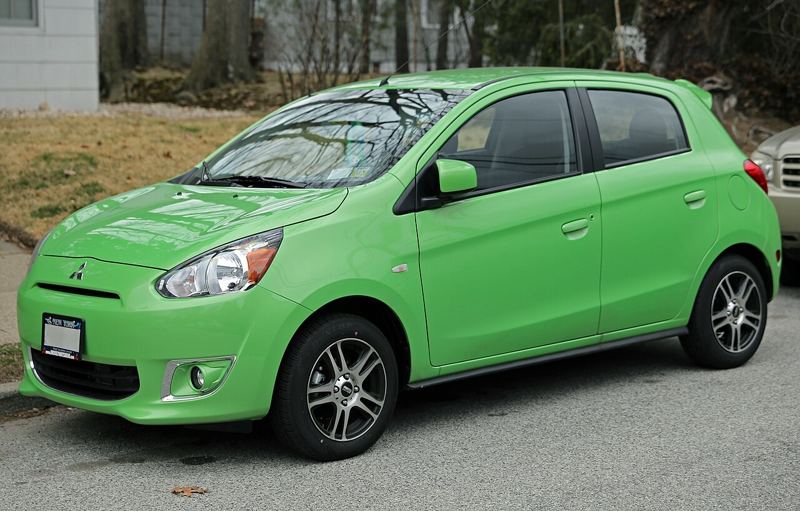
Photo: Mr.choppers · CC BY-SA 3.0 What changed. The Mirage returned to the U.S. for MY2014 as a Thai-built five-door hatchback with a 74 hp 1.2-liter three-cylinder, five-speed manual or CVT, from $12,995 before destination. For MY2017 output rose from 74 to 78 hp, with revised styling, suspension changes for the U.S. model and available Apple CarPlay/Android Auto. The Mirage G4 sedan joined the U.S. lineup for MY2017. The MY2021 restyle adopted Dynamic Shield styling and standard Forward Collision Mitigation with pedestrian detection across U.S. trims.
The innovation. Lightness as a strategy: high-tensile steel in the body and chassis, just 1,973 pounds in base form and a 0.28 drag coefficient. With the CVT it reached 37/44/40 mpg (city/highway/combined), and Mitsubishi billed it as the most fuel-efficient gasoline non-hybrid vehicle in America.
If you buy one usedNHTSA recalls: 15V594 (2014 Mirage built July 27 to November 20, 2013: an impact sensor that, with the SRS warning illuminated, may delay frontal-airbag deployment or prevent side/curtain deployment), 15V815 (2014–2015: salty water from shoes can corrode a connector and delay the front airbags), 16V675 (2017 with HID headlamps: adjustment lock clips not secured), 17V686 (2014–2018 Mirage) and 19V330 (2017–2018 Mirage G4): the airbag module can mistake vibrations for a fault and disable the airbags. Exact Mitsubishi/Mirage queries for 2019–2024 each returned zero campaigns on November 3, 2026. This does not cover every model alias; check the exact VIN and, where applicable, Mirage G4 separately.
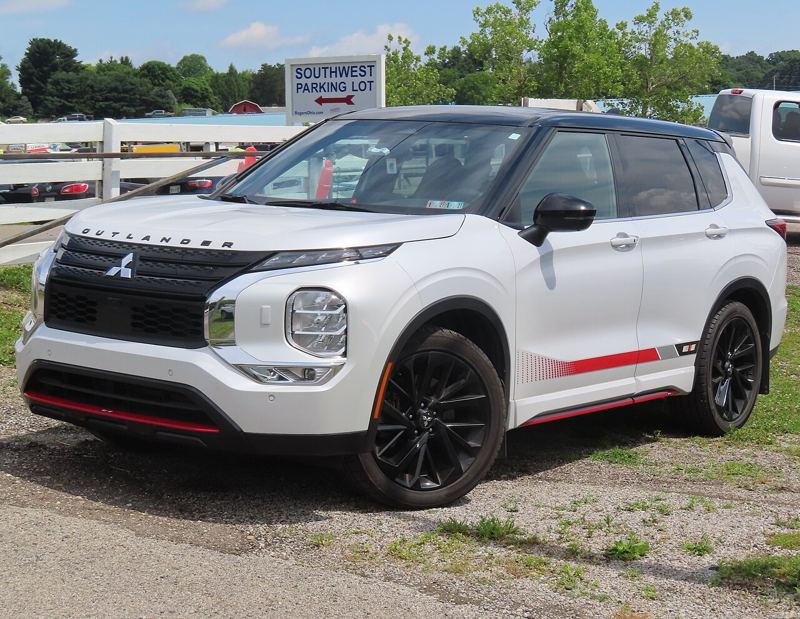 Mitsubishi Outlander2001–present
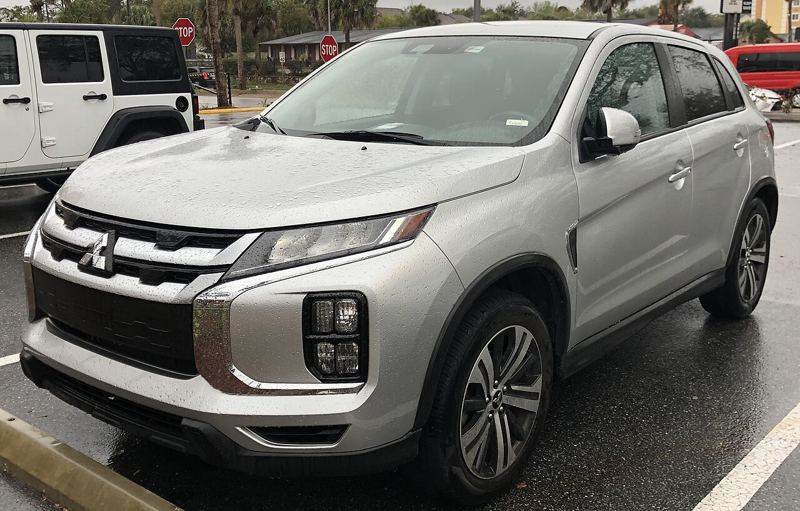 Mitsubishi Outlander Sport2011–present
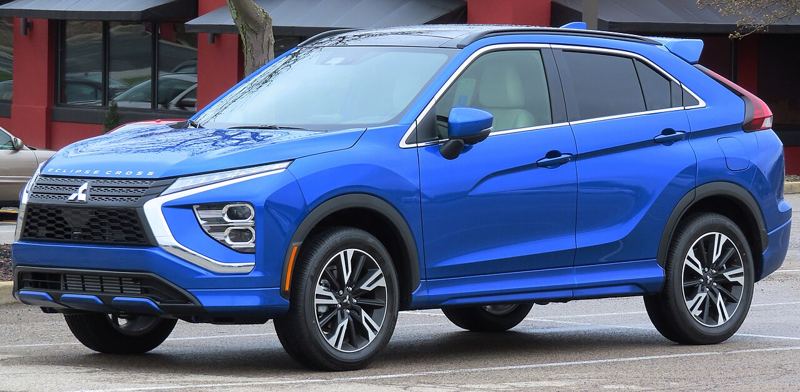 Mitsubishi Eclipse Cross2018–present
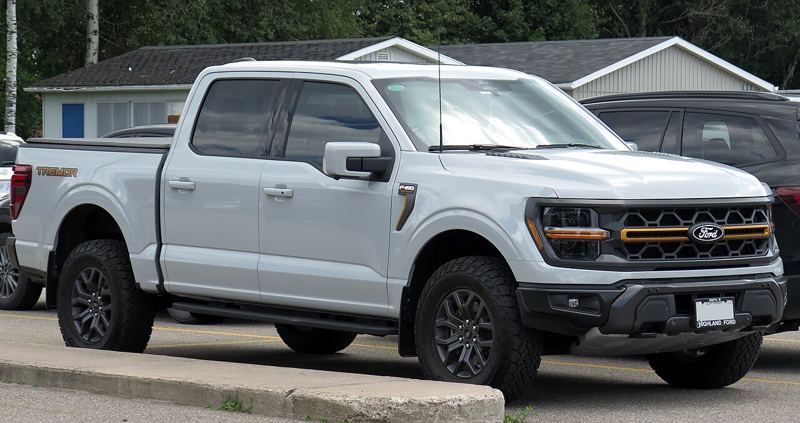 Ford F-Series (F-150)1948–present
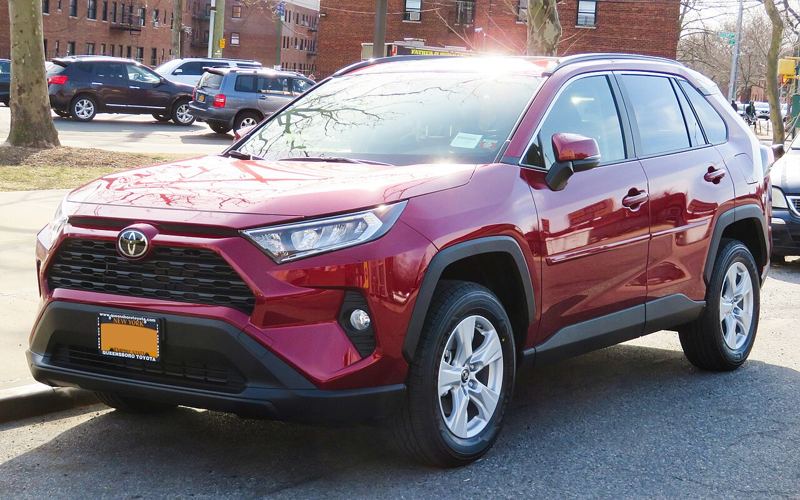 Toyota RAV41994–present (US from 1996)
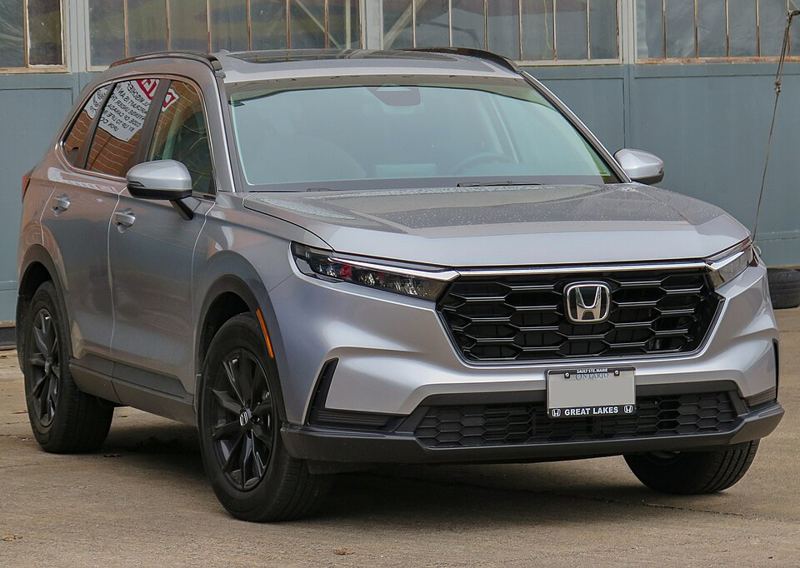 Honda CR-V1995–present
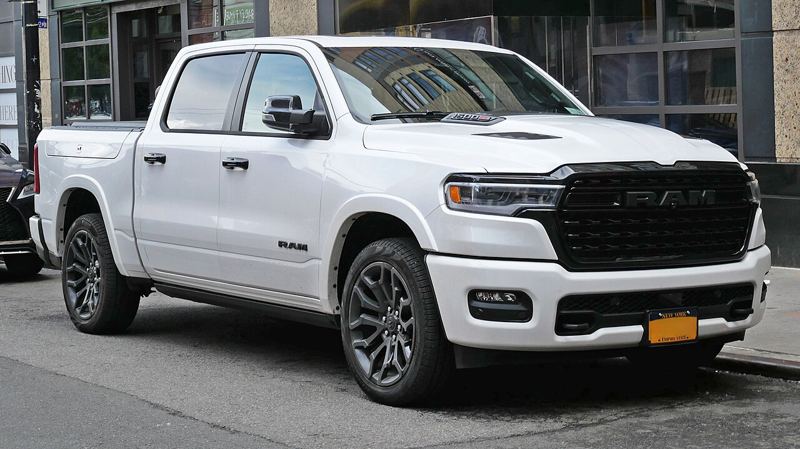 Ram 15001981–present
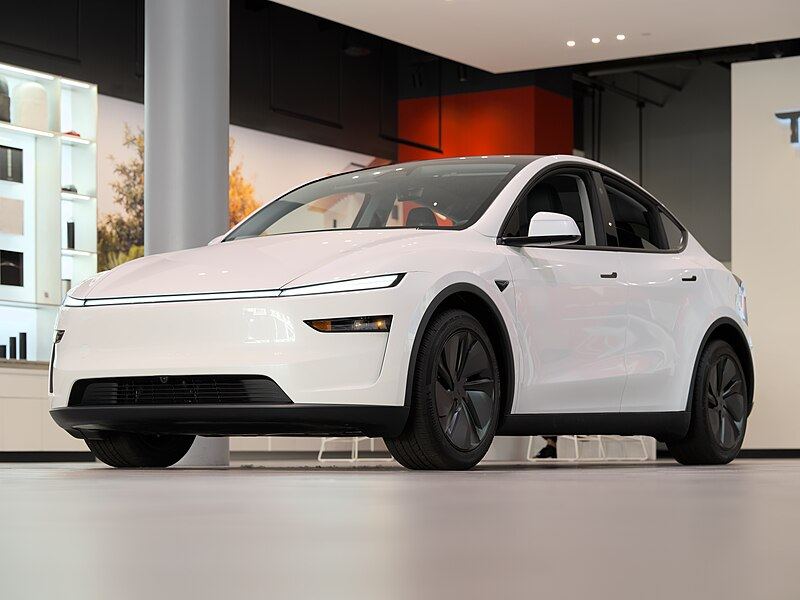 Tesla Model Y2020–present
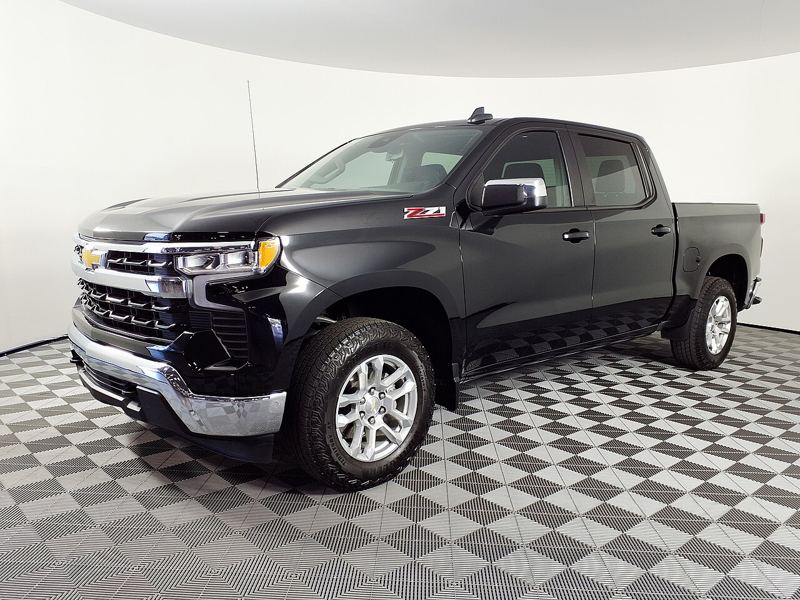 Chevrolet Silverado1999–present


