Dodge Durango
Three-row SUV · 1998–present. 59,357 units sold in the US in 2024
How it began
It was created by the Dodge division of Chrysler Corporation in the late 1990 s as the SUV spun off the Dakota pickup. The reviewed releases do not identify the original designer or chief engineer. For the third generation (2011) there are names: Ralph Gilles, then Chrysler Group's senior vice president of product design, presented it, and the interior came from the same studio that did the Ram and Jeep Grand Cherokee cabins. Reid Bigland (Dodge CEO, 2013), Tim Kuniskis (head of Dodge and SRT, 2017–2021) and Matt McAlear (Dodge CEO since 2024) have led its most recent chapters.
The first two generations were built at Chrysler's Newark, Delaware plant, which received a $623 million investment in 1997 to produce it and closed in December 2008. Since December 14, 2010 the Durango has been assembled in Detroit at the Detroit Assembly Complex – Jefferson (formerly Jefferson North), on the same line as the Jeep Grand Cherokee. It was the first Dodge ever built at that plant. Between Newark and Detroit, more than 2.5 million Durangos have been built.
It arrived as a 1998 model. NHTSA recall records show vehicles built from August 1997, and in its first year it was sold only with four-wheel drive; the two-wheel-drive version came in 1999. The second generation debuted as a 2004 model and the third, current one as a 2011 model, with production starting in November–December 2010. The Newark plant had closed in December 2008.
The reviewed Dodge releases do not explain the choice of name. Durango is the name of a city and state in northern Mexico and of a city in Colorado, in the same vein of Western-flavored names Dodge used at the time, such as Dakota and Ramcharger.
In the mid-1990 s Dodge had no family SUV: its two-door Ramcharger had left the U.S. market in 1993, just as the Explorer, Grand Cherokee and Tahoe were becoming the business of the decade. The answer was to take the Dakota pickup's chassis and add an enclosed three-row body. MotorWeek called it a late entry into the segment, but with a clear pitch: full-size SUV room and V8 power at a midsize price. Dodge recalls that in 1998 it represented a breakthrough in power, size and style.
Generation by generation
- Gen. 11998–2003 · DN
A Dakota with a roof and three rows
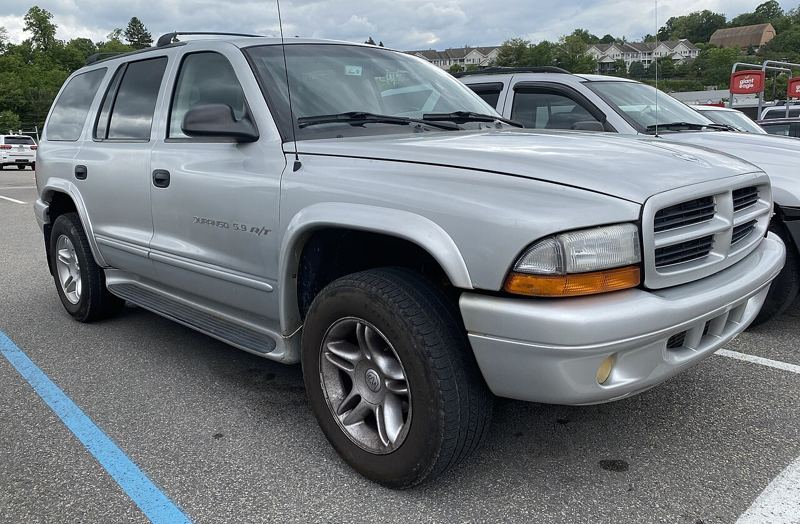
Photo: Cutlass · CC0 What changed. This was the starting point: a body on the Dakota pickup’s frame, sharing its panels from the windshield forward and much of its dashboard. Dodge’s chronology describes MY 1998 as 4WD with a standard 230 hp 5.2 V8 or optional 5.9 V8. The launch brochure also advertised a late-availability 3.9 V6; that announcement does not resolve when it reached customers. The 4.7 V8 joined 4WD models for 2000 and 2WD models for 2001. An optional third row and front bench allowed up to eight seats; maximum cargo volume was 88 cubic feet. MotorWeek quoted a $25,810 base 4WD price for 1998.
The innovation. An optional third row expanded family usefulness in an intermediate-size body. For more power there was the Shelby SP360: Car and Driver recalled its own 1998 test and described 360 hp with a Kenne Bell supercharger.
If you buy one usedCampaigns 99V341 rear brake-tube rubbing and 99V342 fuel-tank strap fatigue were reported December 2, 1999, with notices beginning in February 2000. The former includes specified 1998 vehicles; the latter also includes 1999, with build-dependent combined work. Check 04V596 on specified 2000–2003 4x4 upper ball joints: NHTSA classifies it as a safety-improvement campaign outside the Safety Act. Campaign 01V077 reprograms specified 2001 electric-shift transfer cases that may end up in Neutral. These vehicles are over twenty model-years old; inspect actual corrosion, maintenance and completed work. - Gen. 22004–2009 · HB
Bigger, with a Hemi and even a hybrid
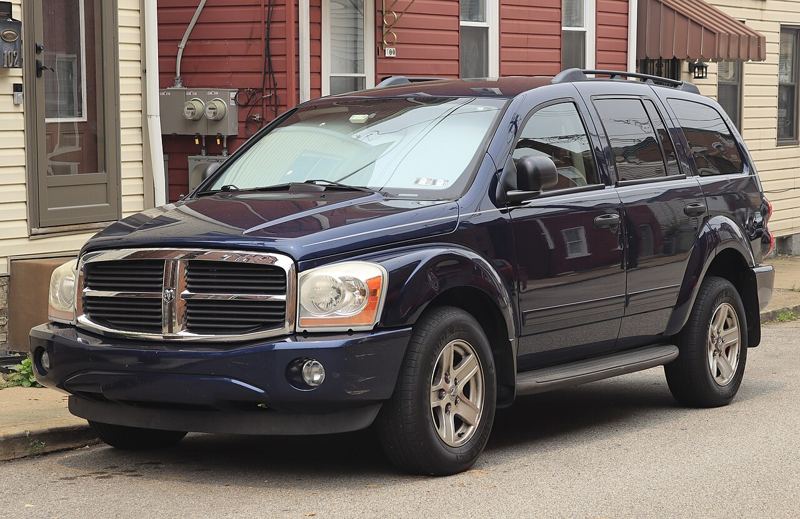
Photo: Cutlass · CC0 What changed. All new from the ground up: a fully boxed hydroformed frame, 7.3 inches longer, 4.5 inches wider, on a 119.2-inch wheelbase, with four-wheel disc brakes and curtain airbags for all three rows. Engines were a 3.7 V6 (210 hp), 4.7 V8 (230 hp, then 303 hp for 2008) and the new 335 hp 5.7 Hemi, with towing of up to 8,950 pounds. In 2007 it gained a luxury twin, the Chrysler Aspen. It was still built in Newark, Delaware.
The innovation. The Hemi in an SUV, the first according to MotorWeek, and in 2009 one of Chrysler’s first two production hybrids, alongside the Aspen: a two-mode system developed with GM, Mercedes-Benz and BMW, 385 combined hp and up to 40 percent better city fuel economy. It did not last: the Newark plant closed that same December 2008.
If you buy one usedFor affected unrepaired Takata vehicles, do not drive until the repair is completed. Check driver-inflator campaigns 15V313 on specified 2004–2008 and 16V947 on specified 2009 Durangos. Older passenger program 14V770 has been superseded by geographically phased 16V352; original-sale and registration history matter, and earlier replacement may require new work. Other selected programs are 04V020 frozen throttle cables on specified 2004 3.7/4.7 engines, 04V578 battery-cable routing on 2004, 05V554 ABS software on 2006, and 09V003 filler check valves on 18,951 specified 2005 Durangos. Confirm actual VIN eligibility and completed repairs. - Gen. 32011–present · WD
Unibody, Pentastar and the SRT era
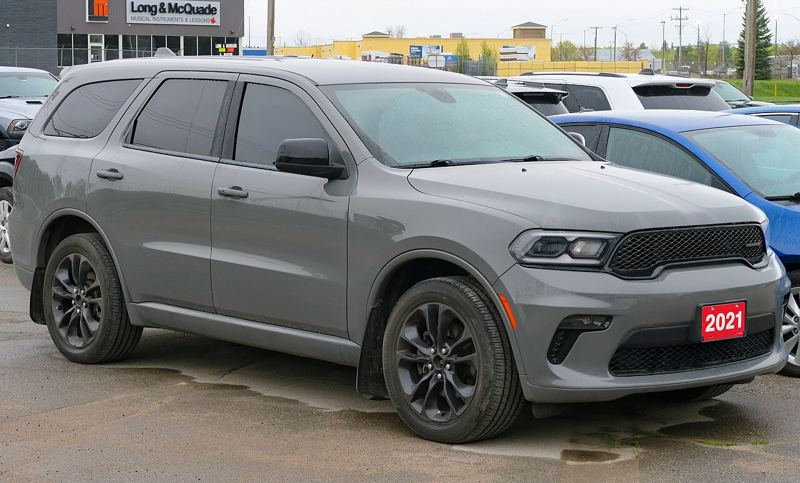
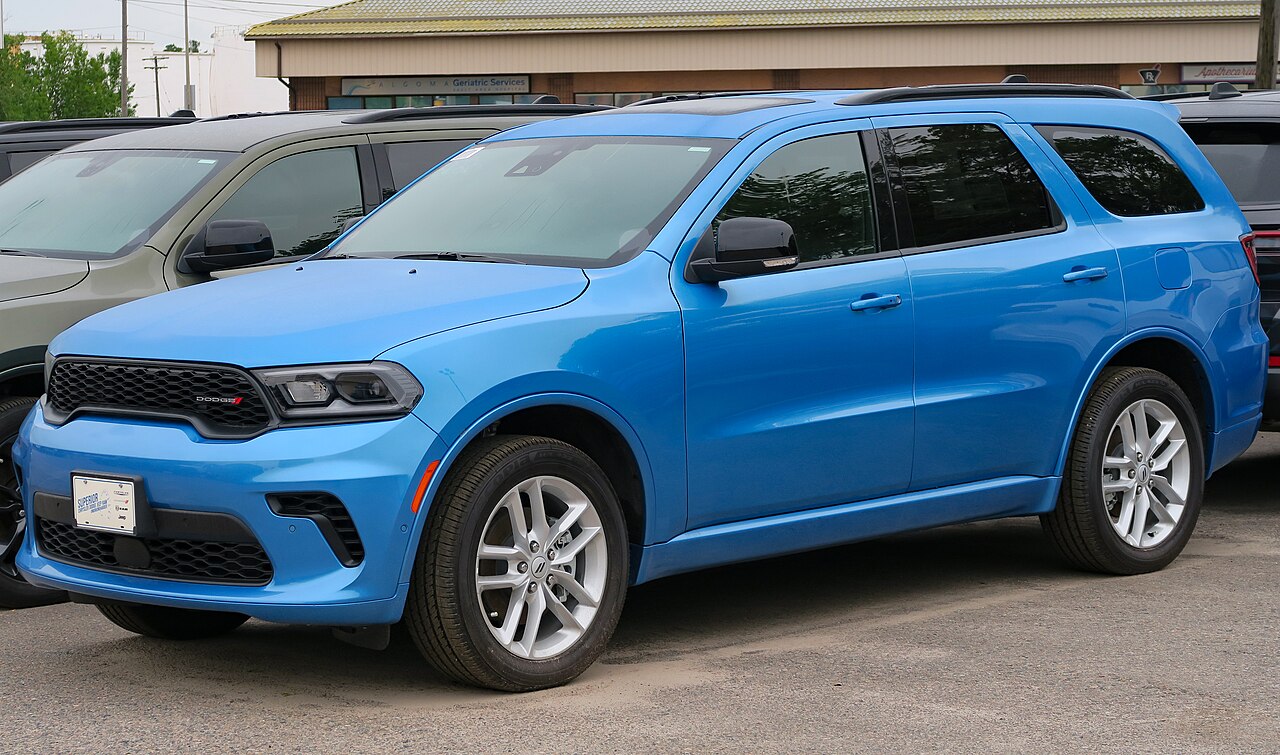
Photo: Elise240SX · CC BY-SA 4.0 What changed. After a year with no Durango, it returned for 2011 on the Jeep Grand Cherokee's platform: a unibody more than 25 percent stiffer than before, independent front and multilink rear suspension, a 290 hp 3.6 Pentastar V6 and a 360 hp 5.7 Hemi. Launch price started at $29,195. In 2014 it gained an eight-speed automatic, an 8.4-inch Uconnect screen and the racetrack LED taillamps; 2018 brought the 475 hp SRT, 2021 the 710 hp SRT Hellcat plus a new face and interior, and the Hemi V8 range expanded for 2026, although Dodge later reopened GT V6 orders.
The innovation. The 2021 SRT Hellcat: a supercharged 6.2 V8 with 710 hp and 645 lb-ft, 0 to 60 mph in 3.5 seconds, an NHRA-timed 11.5-second quarter mile and a 180 mph top speed, with three rows of seats and 8,700 pounds of towing. Dodge calls it the most powerful gas SUV ever.
If you buy one usedFor 2011–2013 fuel-pump relay issues, later 19V813 requires the applicable relay/harness work after 14V530/15V115. Check 14V154/17V572 booster inspection, shields and repeat-installation checks on 2011–2014, plus 2014 ACC and stability software programs 14V293/14V636. On specified 2018–2019 vehicles, 24V838 replaces 22V426 and requires new pressure-transducer/software work even after earlier repairs; its source reports December 16, 2025 letters and describes ABS/ESC loss, false brake lamps and no-pedal Park release. Also check 22V154 steering and 24V436 camera software on 2021–2022; repeat spoiler program 26V528 on 2021–2023; and 26V701 taillights on 2026, with December 3, 2026 notices expected. Verify current remedy availability and records by VIN.
 Dodge Charger1966–present
 Dodge Hornet2023–2025
 Ford F-Series (F-150)1948–present
 Toyota RAV41994–present (US from 1996)
 Honda CR-V1995–present
 Ram 15001981–present
 Tesla Model Y2020–present
 Chevrolet Silverado1999–present
 Nissan Rogue2007–present


