
Mazda Mazda3
Compact car (sedan and hatchback) · 2003–present. 38,877 units sold in the US in 2024
How it began
Mazda Motor Corporation developed Mazda3 with design led by Hideki Suzuki and contributions from its California, Germany and Japan studios; Hasip Girgin designed the production version. The original December 2003 U.S. press release names Akira Tanioka as Mazda3 program manager. For the second generation, the original MY2010 release names program manager Yoshiyuki Maeda and chief designer Kunihiko Kurisu.
Design involved Mazda studios in Japan, the United States and Germany. Production began June 25, 2003 at Hofu in Yamaguchi Prefecture, Japan. In January 2014 the Salamanca, Guanajuato plant began production with a Mazda3 sedan for the United States. The retained MY2026 NHTSA AALA table lists Mexican and Japanese Mazda3 final-assembly variants without allocating those rows to sedan or hatchback; verify the individual vehicle’s VIN and certification label for its assembly origin.
Production began in June 2003, the car was unveiled at the Frankfurt Motor Show in September 2003 and went on sale in Japan in October 2003. In the U.S. it arrived as a 2004 model, as a sedan and a five-door, replacing the Protegé.
Outside Japan it follows the Mazda numbering that began with the Mazda6 and the Mazda2. In Japan its first three generations were called Axela, a name that, according to Mazda, combines accelerate and excellent; the X stands for infinite possibilities.
The Mazda3 replaced a family with a long history: the Familia, first introduced in October 1963, with its sedan following in 1964 and sold outside Japan as the 323, the GLC and, in North America, the Protegé. Mazda planned it as its fourth new-generation product, after the Mazda6, the Mazda2 and the RX-8, and wanted it to compete worldwide on driving, design, quality, space and safety. The goal was to blur the lines between segments: give the compact-car buyer more design, better craftsmanship, more interior room and a European-style drive.
Generation by generation
- Gen. 12004–2009 · BK
The Protegé successor that won over young buyers
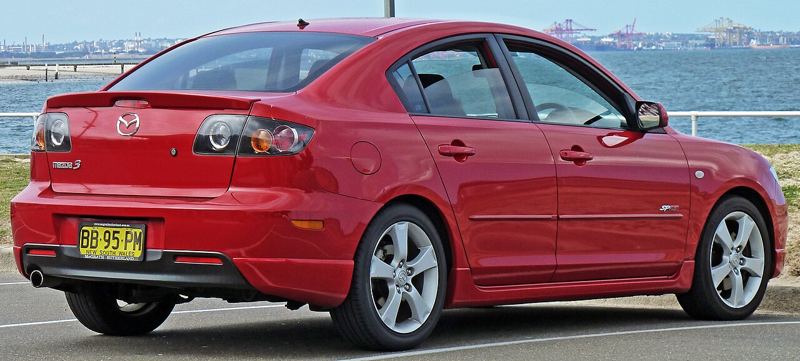
Photo: OSX · Public domain What changed. It replaced the Protegé with a new platform, slightly longer, wider and much stiffer, shared with the Mazda5. In the U.S. it came as a sedan and a five-door, with 2.0- and 2.3-liter engines; the 2.3 made 160 hp and 150 lb-ft, with a five-speed manual or four-speed automatic. In 2007 came the Mazdaspeed3, with a 263 hp, 280 lb-ft direct-injection 2.3 turbo, a six-speed manual and a limited-slip differential.
The innovation. It brought pricier-car equipment to compacts. According to Mazda, it pioneered the availability in its class of navigation, leather seats, xenon headlights, electronic stability control and rain-sensing wipers. In Mazda’s January 2009 U.S. comparison, it also offered the five-door, the body style one third of its customers preferred and that rivals such as the Civic, Focus and Sentra skipped.
If you buy one usedNHTSA lists these Mazda recalls: the plastic emblem on the steering-wheel air bag cover could shatter and throw fragments during deployment (21V494, 2004–2007 Mazda3); 2007–2009 Mazda3s built from April 2, 2007 to November 30, 2008 could suddenly lose power steering assist (10V374); the wiper motor on some 2008–2009 cars, Mazdaspeed3 included, could fail because of a bent terminal (11V329); and 7,100 2009 units with stability control did not meet federal standard 126 (09V187). There was also an air bag crash-sensor recall on the 2004 (04V468). All have a free remedy; check by VIN at nhtsa.gov. - Gen. 22010–2013 · BL
The big smile and North America's first SKYACTIV
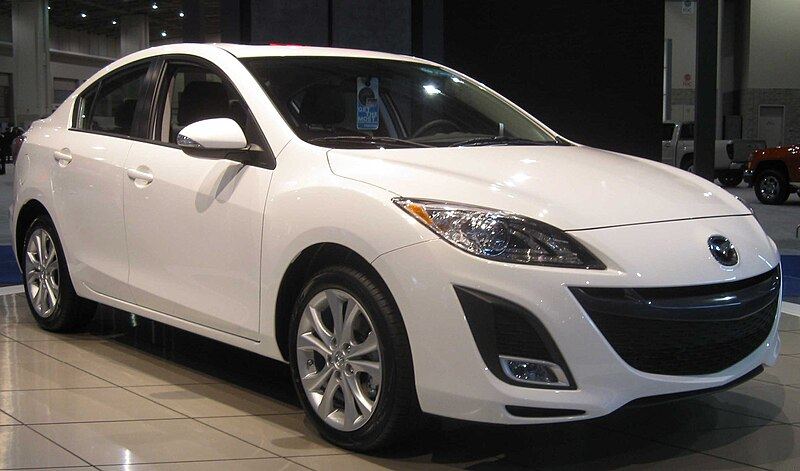
Photo: IFCAR · Public domain What changed. It debuted at the Los Angeles Auto Show in November 2008. It kept the platform but wore a new body with a single, larger grille inspired by Nagare design, which cut aerodynamic drag (from 0.30–0.32 to 0.29–0.31). The 2.3 gave way to a 167 hp, 168 lb-ft 2.5; the 2.0 made 148 hp and a five-speed automatic arrived. The Mazdaspeed3 returned with suspension, brake and engine upgrades.
The innovation. The 2012 Mazda3 was the first vehicle in North America with SKYACTIV technology: a SKYACTIV-G 2.0 engine and new-generation SKYACTIV transmissions. It reached 40 mpg on the highway with no electric motor needed.
If you buy one usedNHTSA lists three Mazda recalls for this generation: the liftgate gas struts on 2010–2013 Mazda3 and Mazdaspeed3 cars built from November 18, 2008 to June 8, 2013 could corrode and break, letting the liftgate drop (16V644); on 2010–2011 cars with a manual seat-height adjuster, the lifter links could break and the seat tilt (17V082); and on 25,400 2010 units the engine harness could rub the starter motor and short-circuit (09V126). All have a free remedy; check by VIN at nhtsa.gov. If you want the best fuel economy, SKYACTIV starts with the 2012 model. - Gen. 32014–2018 · BM/BN
Full SKYACTIV and KODO design
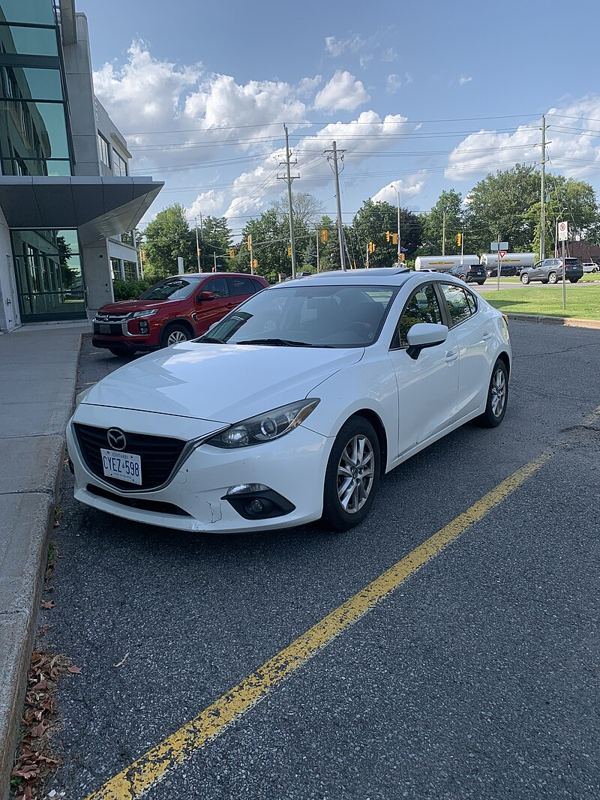
Photo: Sebsoare2511 · CC0 What changed. It went on sale in the U.S. in September 2013 as a 2014 model, fully SKYACTIV and wearing KODO, Soul of Motion design. The wheelbase grew 2.4 inches to 106.3, even though the car got shorter. The 2.0 made 155 hp and the 2.5 made 184 hp, with up to 30/41/34 mpg (city/highway/combined) in the automatic sedan. It introduced i-ACTIVSENSE braking and alerts, the MAZDA CONNECT system and the Active Driving Display. The sedan started under $17,000.
The innovation. i-ELOOP, which Mazda introduced as the world's first capacitor-based regenerative braking system to power all of a vehicle's electrical components. When you lift off the gas it turns motion into electricity for lights, climate and audio, so the engine burns less fuel. With i-ELOOP and active grille shutters, the sedan reached a 0.255 drag coefficient.
If you buy one usedNHTSA lists several Mazda recalls: on 2.5-liter cars with i-ELOOP built from June 12 to December 18, 2013, the alternator belt could slip in heavy rain and the car could stop charging (14V173); there were three distinct fuel defects: failed inlet-check-valve weld attachments (16V684, 2014–2016), an incorrectly installed shut-off-valve cap allowing leakage through the evaporative system (15V621, 2015–2016), and manufacturing deformation of the tank with leakage at a recirculation-pipe weld (16V685, 2016); the parking brake actuator could corrode and bind (17V393, 2014–2016); the wiper relay could fail (19V272, 2016–2018); the rearview camera image could flicker or distort (23V487, 2014–2018); and the 2018 had recalls for an incorrect valve spring (17V745) and the fuel pump (21V875). All have a free remedy; check by VIN at nhtsa.gov. - Gen. 42019–present · BP
Award-winning design and all-wheel drive
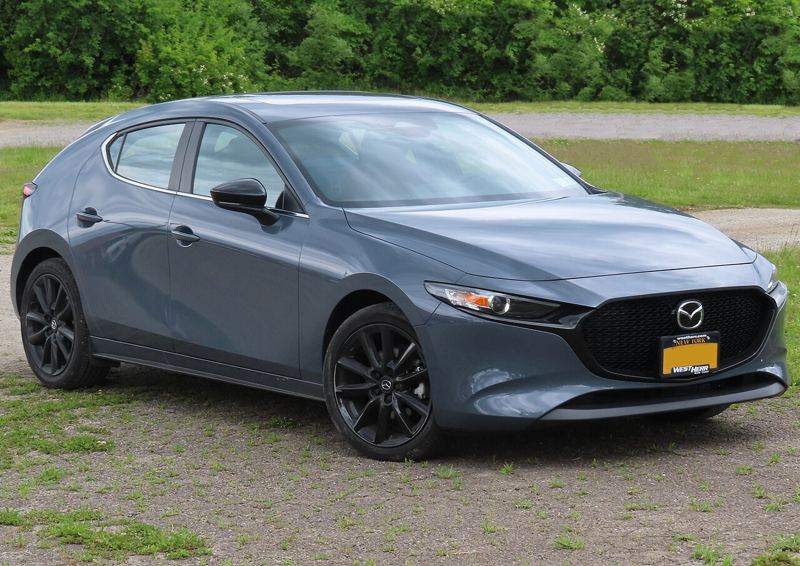
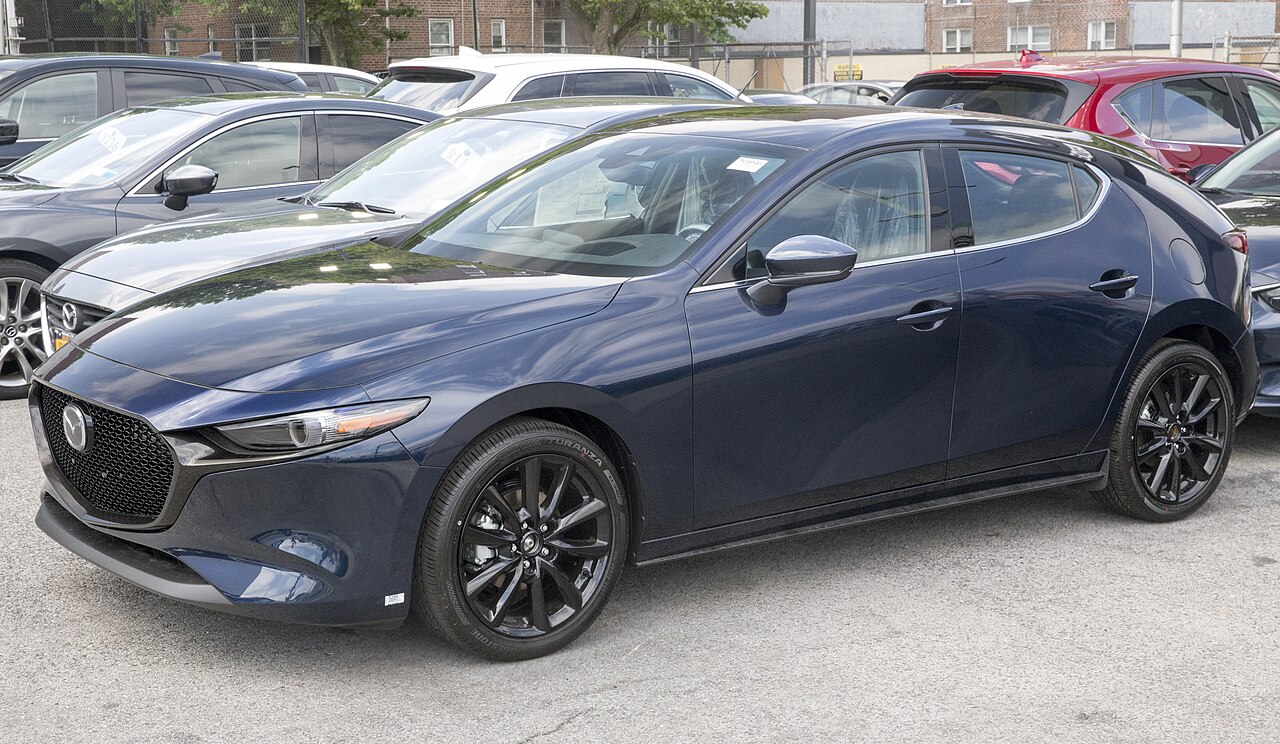
Photo: MercurySable99 · CC BY-SA 4.0 What changed. It debuted at the Los Angeles Auto Show in November 2018 on the new SKYACTIV-Vehicle Architecture, with a new design approach giving the sedan and hatchback distinct personalities. In the U.S. it brought a 186 hp 2.5, with cylinder deactivation on hatchbacks and selected sedan configurations, optional i-ACTIV AWD and G-Vectoring Control Plus, starting at $21,000 for the sedan. For 2021 it added the 2.5 Turbo with 250 hp and 320 lb-ft on premium fuel, always with all-wheel drive.
The innovation. This generation introduced the Skyactiv-X engine, which ignites gasoline by spark-controlled compression ignition (SPCCI) and works with a 24-volt mild-hybrid system; Mazda offered it in markets such as the UK. And its design won the 2020 World Car Design of the Year award.
If you buy one usedNHTSA lists loose wheel nuts (19V425, 2019), false obstacle detection with sudden braking (19V907, 2019–2020), and software that could stall the engine (19V497, 2019). Certain 2019 cars also had head-restraint problems (19V514), manual-dimming interior mirrors that could detach (19V558), and passenger airbag/seatbelt indicators (19V363). Other campaigns cover front-caliper bolts (20V346, 2020) and tire valves (21V101, 2021). Exact Mazda/Mazda3 queries for 2022 and 2023 saved on November 3, 2026 returned zero records; verify the VIN. Later campaigns are 23V718 for camera images on certain 2024 cars, 24V649 for the forward camera disabling automatic braking and lane-keep assistance on certain 2024 cars, and 25V357 for airbag-sensor units on certain 2024–2025 cars that could deactivate airbags after a low battery. Each campaign publishes a free remedy for eligible affected vehicles; confirm repairs by VIN at nhtsa.gov.
 Mazda CX-52012–present
 Mazda CX-302020–present
 Mazda CX-502023–present
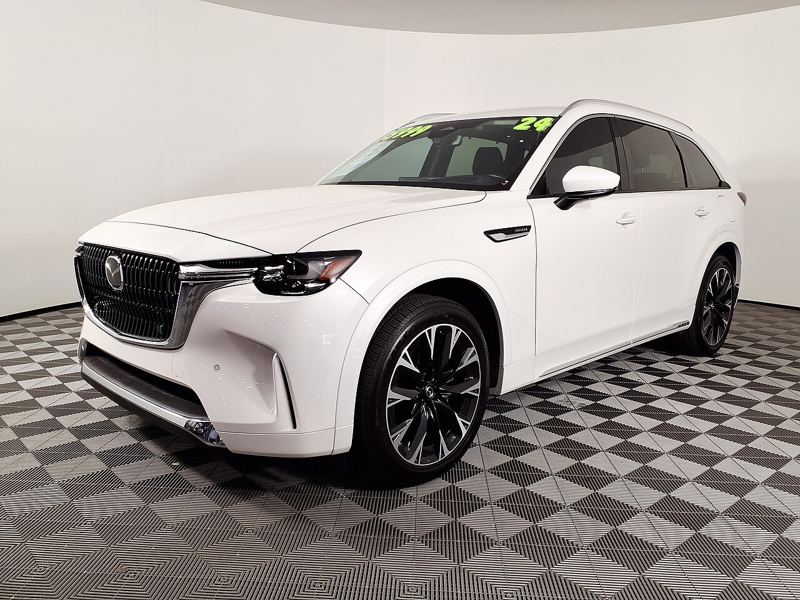 Mazda CX-90 (CX-9)2007–present
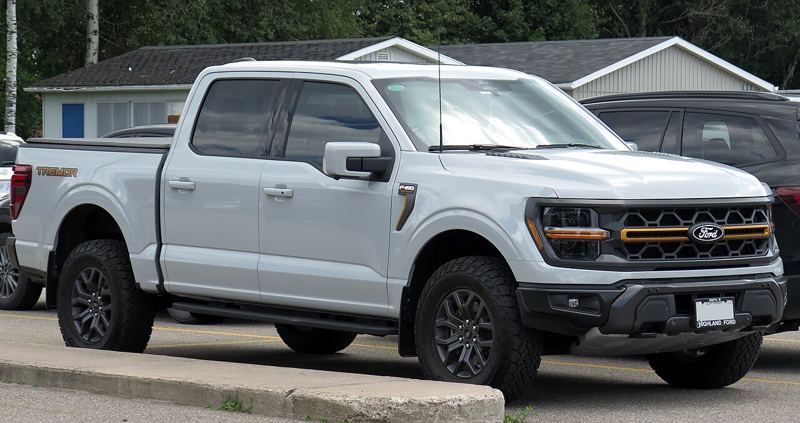 Ford F-Series (F-150)1948–present
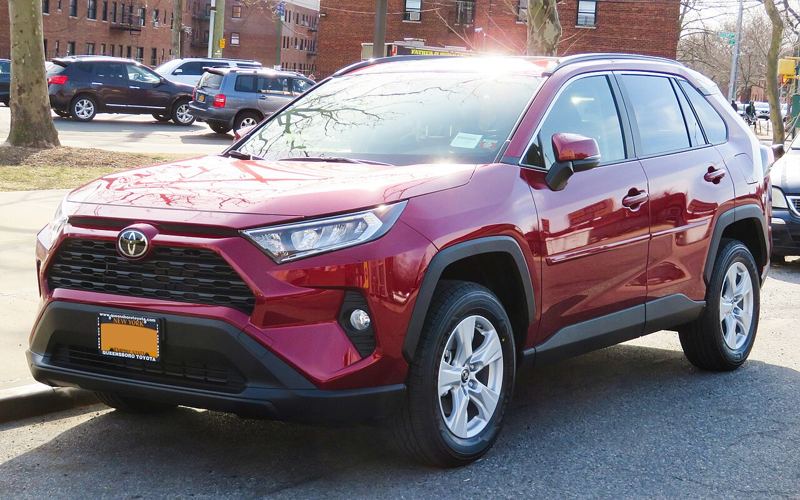 Toyota RAV41994–present (US from 1996)
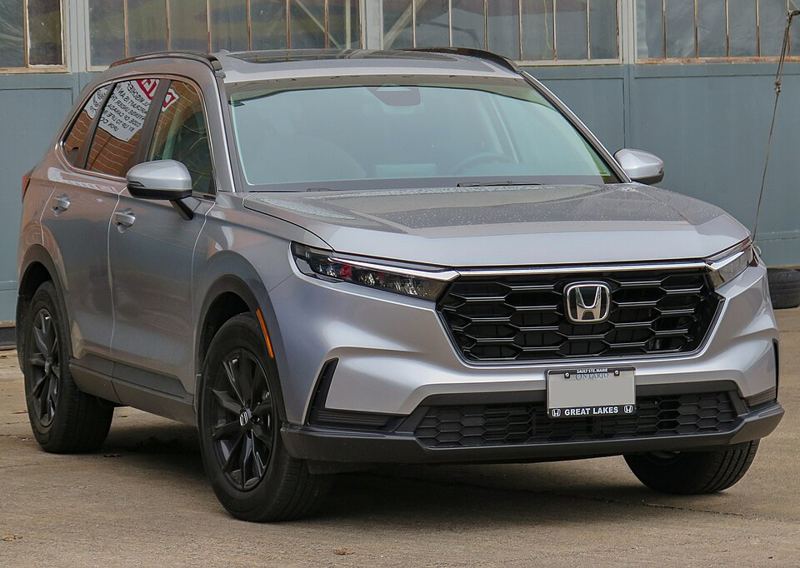 Honda CR-V1995–present
 Ram 15001981–present
 Tesla Model Y2020–present


