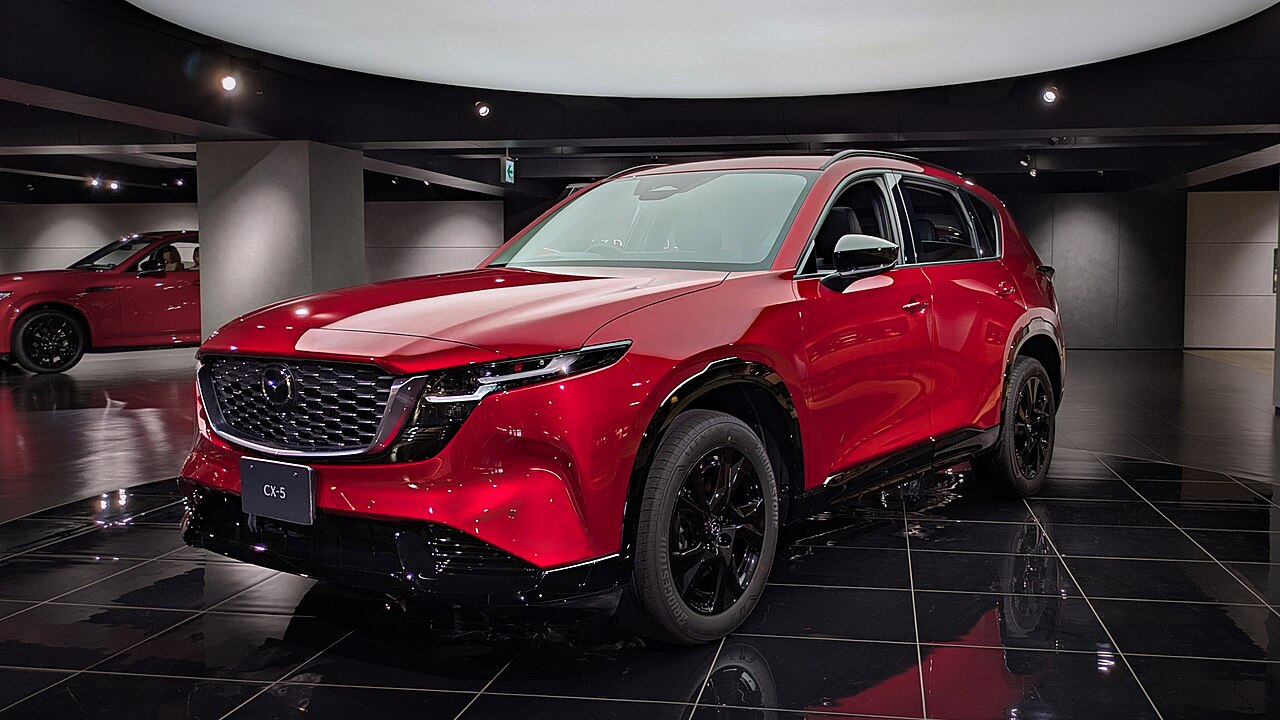
Mazda CX-5
Compact SUV · 2012–present. 134,088 units sold in the US in 2024
How it began
Mazda Motor Corporation, in Hiroshima, Japan. The original CX-5 was styled by Masashi Nakayama, general manager of Mazda's design division, who set out to bring sporty design elements to an SUV. Takanori Tsubaki was chief designer of the updated version. Documented program managers include Masashi Otsuka (2015) and Koichiro Yamaguchi (2026). Mazda’s 2012 technical review publishes Hideaki Tanaka as coauthor of the CX-5 introduction. A contemporary firsthand interview identifies him as the original development chief, appointed to the CX-5 program in May 2009.
Production began in November 2011 at Ujina Plant No. 2 near Mazda’s Hiroshima headquarters. A later completed-event chronology dates expansion to Ujina No. 1 to February 2013; the earlier plan had named March. Hofu Plant No. 2 in Yamaguchi began CX-5 production on October 17, 2017, ahead of the earlier November forecast. Mazda’s January 2026 history says Hofu no longer produces CX-5. The U.S. MY2026 NHTSA AALA row identifies Japanese assembly without a precise plant allocation. Mazda also documents production or local assembly in China, Malaysia and Vietnam for those markets.
The Minagi concept was shown at the Geneva Motor Show in March 2011; the CX-5 name was announced on April 18, 2011, and the production car debuted in Frankfurt in September 2011. Global sales began in February 2012. In the United States it was unveiled at the November 2011 Los Angeles Auto Show and reached dealers in 2012 as a 2013 model, starting at $20,695.
According to Mazda, 'CX' identifies its crossover SUV line-up, which in 2011 already included the CX-7 and CX-9. The 5 places it as the compact model in that series.
Mazda’s own history describes pursuing independent products and new technology after Ford reduced its stake following the 2008 crisis. Ford had held 33.4%; its November 2010 share-transfer announcement put the remaining stake at 3.5% while retaining a strategic partnership. CX-5 became the first production Mazda to combine Kodo with the complete SKYACTIV engine, transmission, body and chassis package, entering the growing compact-SUV segment. Strong orders led Mazda to raise its fiscal-2012 global target from 160,000 to 190,000. The second generation’s 2016 development slogan was an SUV all customers will enjoy. For calendar 2025, the manufacturer’s global figures were 334,578 CX-5 out of 1,256,215 Mazda sales, about 26.6%.
Generation by generation
- Gen. 12013–2016 · KE
The first full SKYACTIV and KODO Mazda
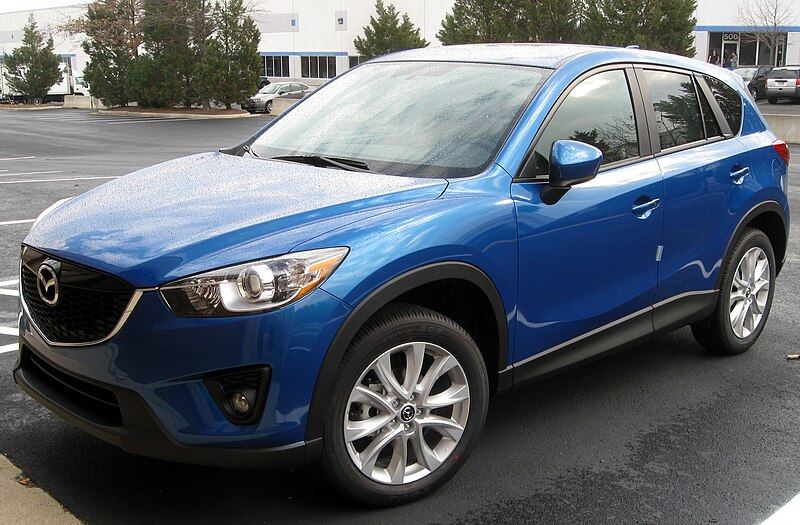
Photo: IFCAR · Public domain What changed. It was all new from the ground up: the first production vehicle with the KODO (Soul of Motion) design that debuted on the Shinari concept, and the first with the full SKYACTIV range: engine, transmission, body and chassis. In the U.S. it arrived as a 2013 model with a 155 hp 2.0-liter engine, a six-speed manual or automatic, and up to 35 mpg highway. For 2014 it added the 184 hp 2.5-liter and Smart City Brake Support, and for 2016 it got a refresh with adaptive LED headlights and the Mazda Connect system.
The innovation. The complete SKYACTIV package in one car: SKYACTIV-G gasoline engine, SKYACTIV-Drive transmission, SKYACTIV body and chassis. With a 0.33 drag coefficient and 3,194 pounds in its lightest form, it returned 26/35/29 mpg (city/highway/combined) with the manual, compact-car numbers in an SUV.
If you buy one usedNHTSA lists four Mazda recalls for this generation: the liftgate support struts could corrode and break, letting the liftgate drop (16V644, 2013–2016 CX-5); the fuel filler pipe could rupture in a crash (16V064, 2014–2016); the lower nuts attaching the front strut to the steering knuckle could loosen and cause loss of steering (16V203, 2014–2016); and the LED daytime running lights could fail while driving (20V063, 2016). There is also a Pilkington recall for replacement windshields whose Smart City Brake Support laser-sensor bracket was attached with tape only (16E002). All have a free remedy; check by VIN at nhtsa.gov. If you want more power, look for the 2.5-liter from 2014 on. - Gen. 22017–2025 · KF
More refined, with a turbo and standard all-wheel drive
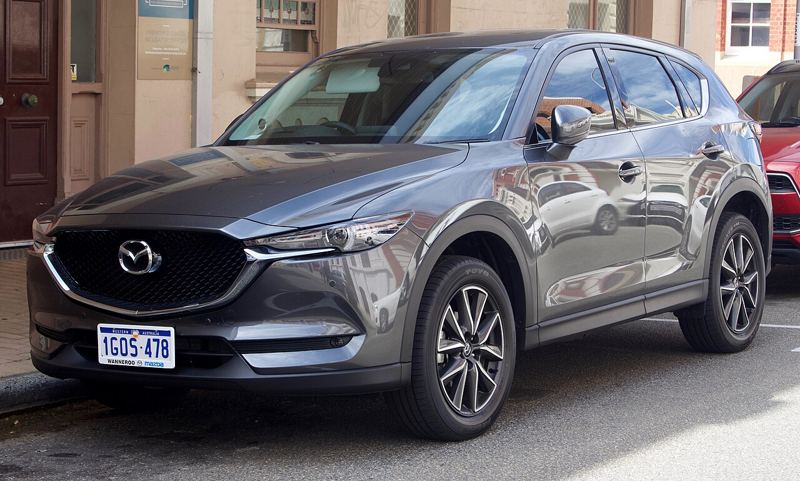
Photo: EurovisionNim · CC BY-SA 4.0 What changed. It debuted at the Los Angeles Auto Show in November 2016 and production began on November 28, 2016 at Ujina Plant No. 2; Hofu Plant No. 2 joined on October 17, 2017. It kept the KODO look but with a quieter cabin and a more comfortable ride, and it introduced the Soul Red Crystal color. In the U.S. the 2.5-liter made 187 hp; for 2019 the 2.5 turbo arrived with 250 hp on premium fuel (227 hp on regular) plus the Grand Touring Reserve and Signature trims; and for 2022 i-Activ all-wheel drive became standard on every trim, with the turbo at 256 hp on premium fuel.
The innovation. G-Vectoring Control, the first of the SKYACTIV-Vehicle Dynamics technologies: the engine trims its torque as you turn the wheel to load the front tires and make the car respond more naturally. In 2019 it evolved into G-Vectoring Control Plus.
If you buy one usedThe retained NHTSA snapshot lists four campaigns for this phase: accessory hitch wiring that could contact the exhaust and affect trailer lights (17V744, 2017); curtain airbags that might unfold improperly (18V426, 2018); PCM software that could stall the engine (19V497, 2018–2019); and low-pressure fuel-pump impellers that could crack or deform and cause stalling (21V875, 2018–2019). Exact Mazda/CX-5 queries for 2020–2025 saved on November 3, 2026 returned zero records; check the VIN. Mazda’s official history confirms nine consecutive years of IIHS Top Safety Pick+ through February 2022; IIHS lists Top Safety Pick for 2024. The Turbo, introduced for 2019, has a higher published horsepower rating with 93-octane fuel than with 87-octane fuel. - Gen. 32026–present · KM
A giant screen, Google built in and a hybrid on the way
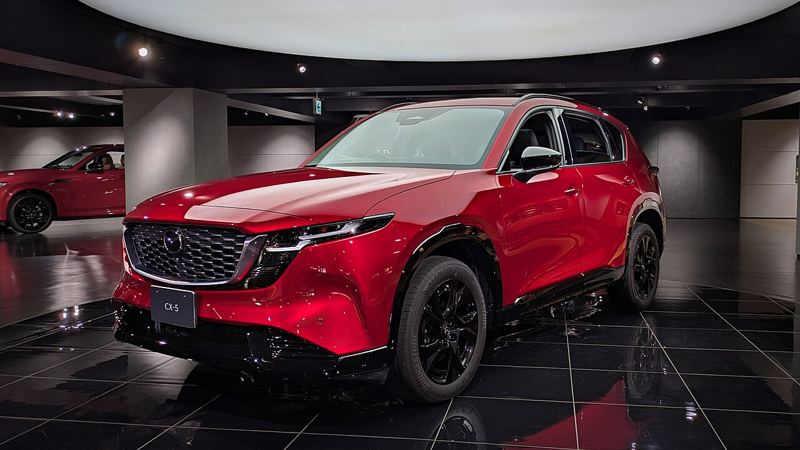
Photo: Aos.1905 · CC BY 4.0 What changed. Unveiled in Europe on July 10, 2025, the third generation was scheduled for a North American launch in spring 2026. U.S. pricing was announced January 13, 2026 from $29,990 before destination. Program manager Koichiro Yamaguchi described a full change after eight years, more passenger space and a redesigned interface. The U.S. model keeps a 187 hp 2.5-liter Skyactiv-G, six-speed automatic and standard i-Activ AWD, with a 110-inch wheelbase. Mazda announced its own hybrid powertrain for 2027; this remains a future plan.
The innovation. Google built in with navigation and voice assistant on a 12.9-inch center screen, or 15.6 inches on the Premium Plus, the largest ever offered on a Mazda.
If you buy one usedThis generation still has a short track record. Exact NHTSA Mazda/CX-5 queries for model-years 2026 and 2027 saved on November 3, 2026 returned zero records; this does not replace a VIN check. The U.S. 2026 launch equipment list includes standard radar cruise control, front and rear automatic braking, blind-spot monitoring and rear cross-traffic alert on all trims. Confirm recall applicability and equipment by VIN before buying.
 Mazda CX-302020–present
 Mazda CX-502023–present
 Mazda CX-90 (CX-9)2007–present
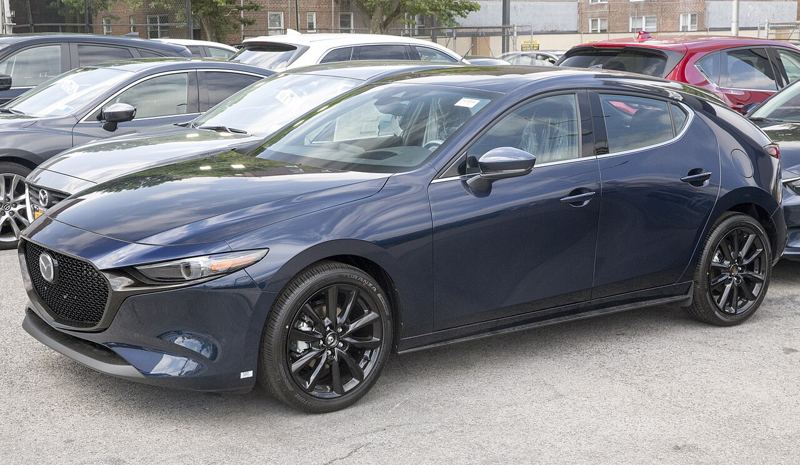 Mazda Mazda32003–present
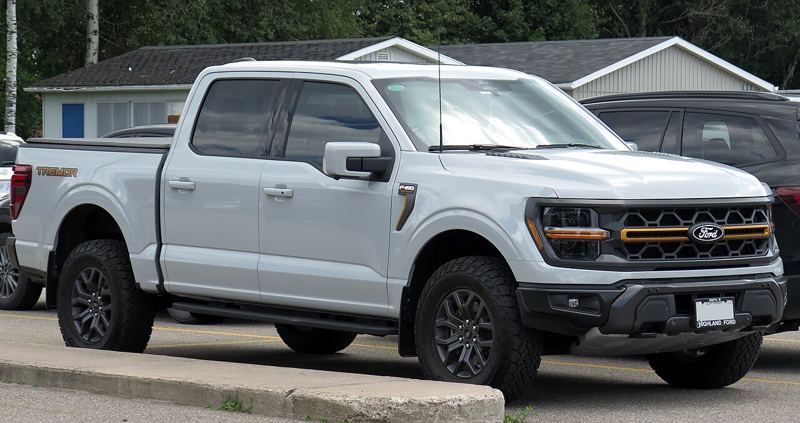 Ford F-Series (F-150)1948–present
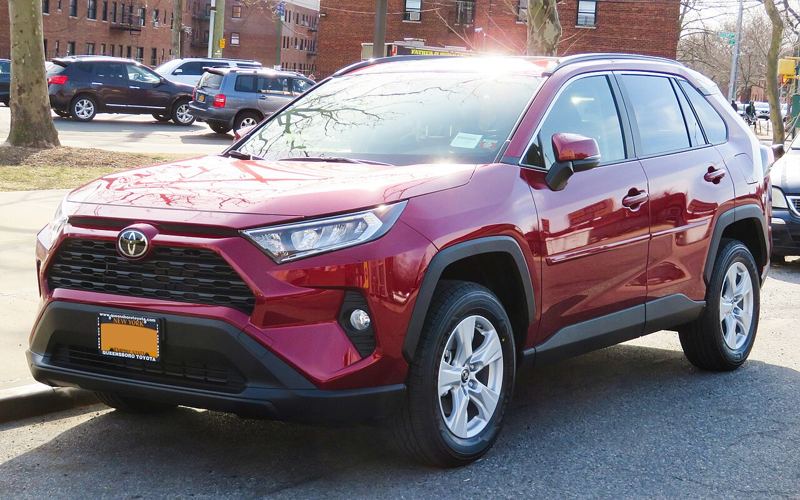 Toyota RAV41994–present (US from 1996)
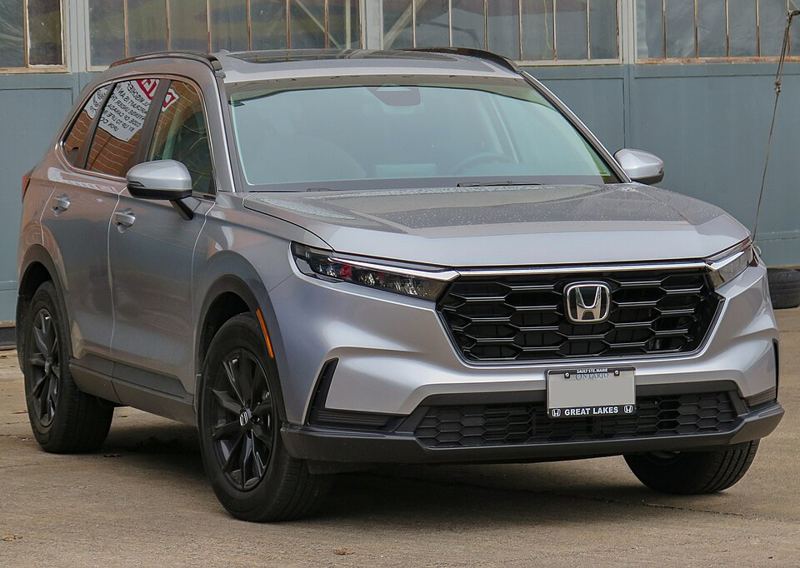 Honda CR-V1995–present
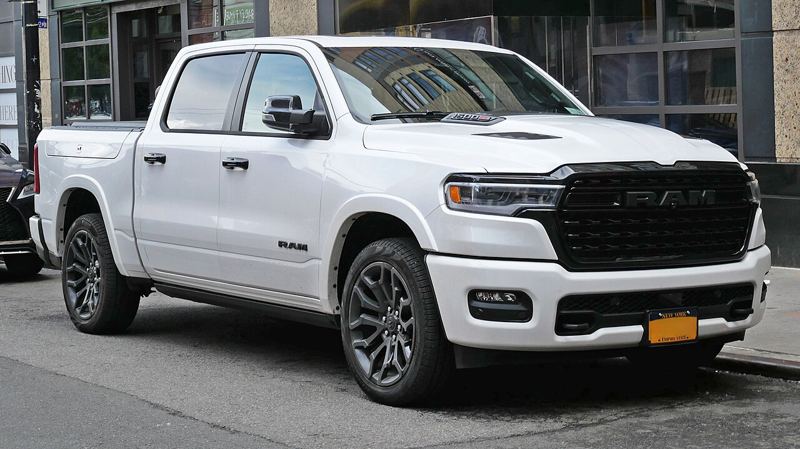 Ram 15001981–present
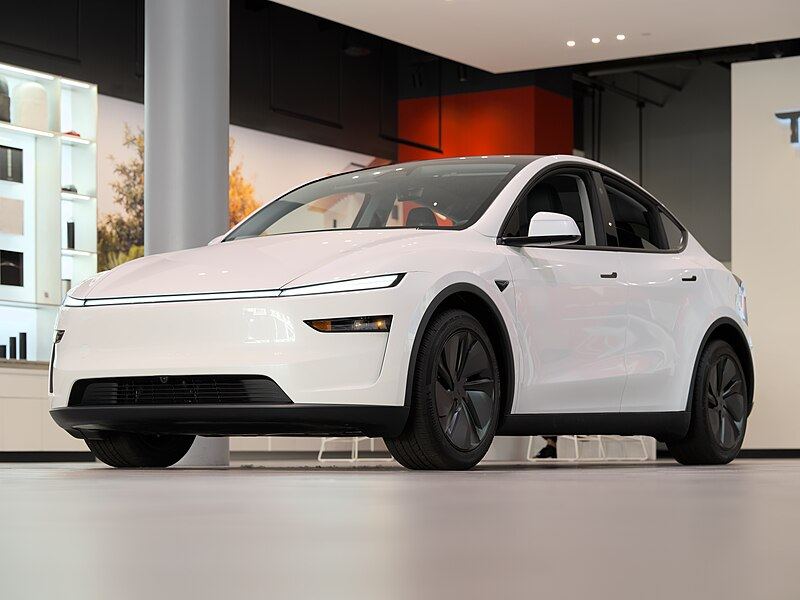 Tesla Model Y2020–present


