
Toyota Corolla
Compact sedan · 1966–present. 232,908 units sold in the US in 2024
How it began
Chief engineer Tatsuo Hasegawa, a former aircraft designer who joined Toyota in 1946 and had already led the Publica and the Sports 800. Hasegawa drew up the Corolla concept in late 1962 and started full-scale development in 1963, with a quality scoring system in which every area of the car had to beat its target: the "80-plus points in everything" idea. Shirou Sasaki worked under him and later led the second and third generations.
Designed in Japan and built from September 1966 at Takaoka in Toyota City, Aichi, a plant constructed for Corolla with a 30-billion-yen investment. Toyota’s 2027 U.S. model announcement assigns gasoline Corolla sedans to Blue Springs, Mississippi, and Corolla Hybrids to Takaoka, Japan.
The first Corolla left the Takaoka line in September 1966, with Japanese sales beginning in November at Tokyo prices of 432,000–495,000 yen. Exports to Australia began in 1966 and U.S. exports in April 1968.
"Corolla" comes from Latin and means "crown of flowers" (the corolla is the ring of petals). The team searched English, Italian and French dictionaries and even the Japanese poetry anthology Man'yoshu, hoping the car would bloom in the market. It also fit Toyota's habit of using names starting with "C", like Crown and Corona.
In the mid-1960s Japan was opening expressways after the 1964 Tokyo Olympics, its population had passed 100 million and commute times were growing. Toyota predicted a motorization boom and needed a car between the 800 cc Publica and the 1,500 cc Corona. Hasegawa's goal was not a basic vehicle but a car its owner would be proud of, one that could compete with Europeans in its class. That is why the engine grew from 1,000 to 1,100 cc, to stay 100 cc ahead of the rival Nissan Sunny.
Generation by generation
- Gen. 11966–1970
The people's car that dreamed big
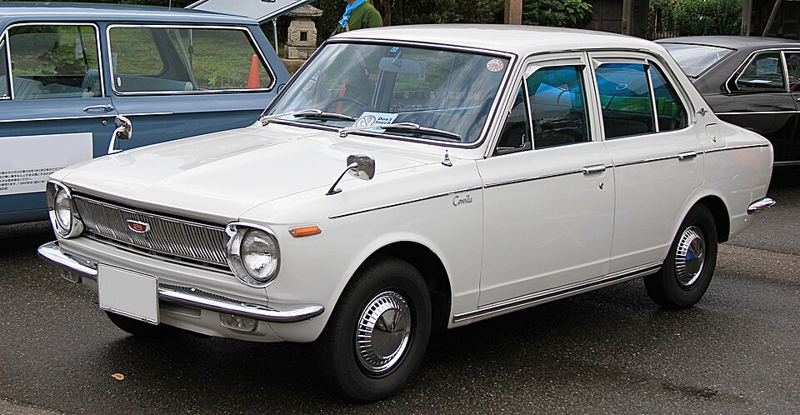
Photo: TTTNIS · CC0 What changed. It was born as a two-door sedan and soon added four doors and a wagon. Its 1,077 cc K engine made 60 PS with a five-bearing crankshaft, and the gear lever sat on the floor instead of the steering column, unusual at the time. Within three years it was Japan's best-selling car.
The innovation. It was the first Japanese car with MacPherson strut front suspension. One prototype failed after 500 meters and the setup took two and a half years to perfect. It also brought Japan its first fully synchronized four-speed floor-shift manual and a two-speed automatic.
If you buy one usedToyota says the Corolla arrived in the U.S. in spring 1968 as a 1969 model. NHTSA has historical records for these cars: 69V140 concerns certain 1969 manual gearshift levers, and 70V023 concerns the specified brake-pedal, reservoir-cap and brake-tube conditions. Ask Toyota or a qualified specialist about actual eligibility, repair records and parts availability. Inspect body corrosion and the vehicle’s actual condition; age or low mileage alone does not establish roadworthiness. - Gen. 21970–1974
The body grows and the Levin is born
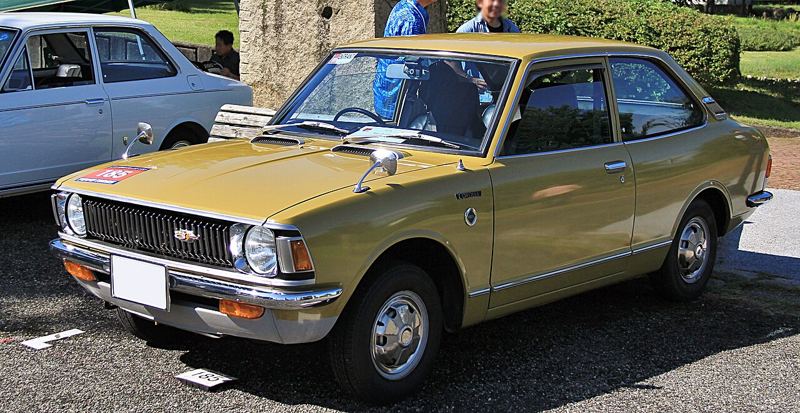
Photo: TTTNIS · CC0 What changed. Larger and with rounder lines, it added a fastback coupe to the sedans and wagon. The 1.2-liter 3K engine came in three versions and the 1.4-liter T engine followed soon after. Toyota built 2,406,860 units of this generation.
The innovation. In March 1972 came the Corolla Levin (TE27), a coupe with the 1.6-liter twin-cam 2T-G engine rated at 115 PS. Weighing 855 kg with a 118 mph top speed, it won the 1975 1,000 Lakes Rally against European rivals.
If you buy one usedHistorical NHTSA campaigns include 71V084 for certain 1971 cars, where objects from the package tray could interfere with accelerator linkage, and 72V014 for evaporative-emissions-system problems that could cause hesitation or stalling. Verify the actual vehicle and completed work. If seeking an original TE27 Levin, check chassis and engine documentation: Toyota identifies its 1,588 cc 2T-G twin-cam specification in the original model history. Do not assume a present U.S. car was delivered in that Japanese-market configuration. - Gen. 31974–1979
The Corolla dethrones the Beetle
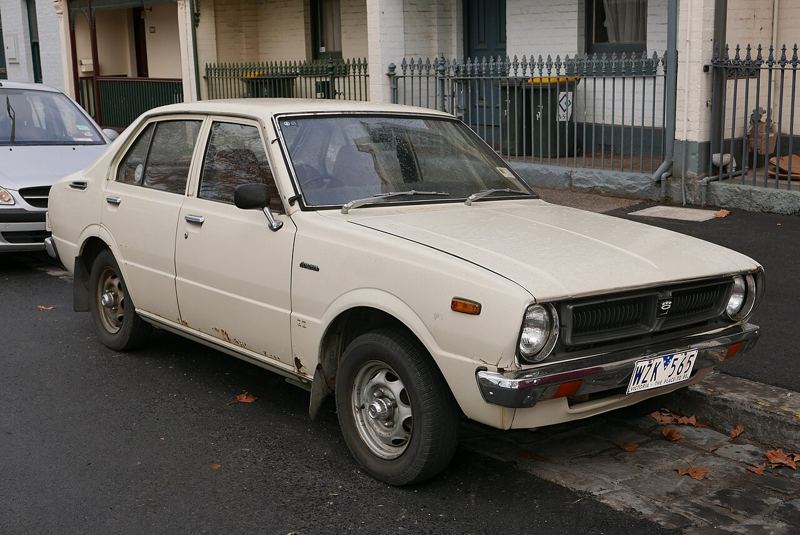
Photo: OSX · Public domain What changed. Introduced in April 1974 as the ultimate family car, it grew toward Corona size for collision protection and adopted angular styling. Its sporty multipurpose Liftback proved more popular abroad than in Japan. Toyota’s history says fiscal-1974 annual Corolla production overtook the Volkswagen Beetle and calls it the world’s best-selling car; this generation totaled 3,755,029 vehicles.
The innovation. It was the first Toyota with three-point emergency-locking seatbelts on every model, and the first Corolla tested in a wind tunnel. To meet 1975 emissions rules it introduced catalytic converters and lean combustion, and the Levin swapped Solex carburetors for electronic fuel injection.
If you buy one usedCheck historical steering campaign 80V028 on certain 1977–1979 Corollas: a loose worm-gear bearing/adjuster lock nut could cause steering instability, requiring inspection and securing where needed. Verify the actual engine, emissions equipment and build records. Toyota’s historical export and emissions-development accounts do not determine how many cars survive locally or establish one engine-code rule for every market. - Gen. 41979–1983
Four round headlights and ten million
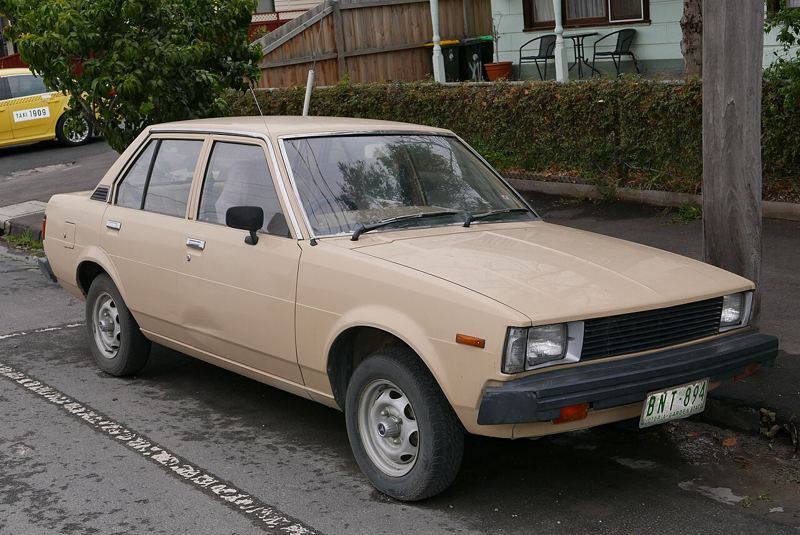
Photo: OSX · Public domain What changed. Launched in March 1979 under chief engineer Fumio Agetsuma, it retained the front-engine, rear-drive architecture across the generation. Initial sedans and vans used four round headlights, while coupes used rectangular lamps; later facelifts changed the lighting. Its boxy body achieved a 0.35 drag coefficient after more than 400 wind-tunnel hours. Cumulative Corolla production reached 10 million in March 1983.
The innovation. Passenger-car development introduced a four-link rear suspension with coil springs and a lateral rod, replacing the earlier leaf-spring design. Toyota’s detailed record identifies rack-and-pinion steering on the 1.3-liter versions. The first diesel Corolla arrived in February 1982 with the 1.8-liter, 65 PS 1C engine.
If you buy one usedNHTSA campaign 80V045 concerns certain 1980 alternator pulleys that could crack and break; the published remedy replaces the pulley. Toyota’s Japanese 3A-U head-cracking account concerns development prototypes and countermeasures completed by February 1979 before production. Inspect the actual engine and cooling-system history, and verify its identity rather than infer present condition from historical worldwide export totals. - Gen. 51983–1987 · E80
The leap to front-wheel drive and the AE86 legend
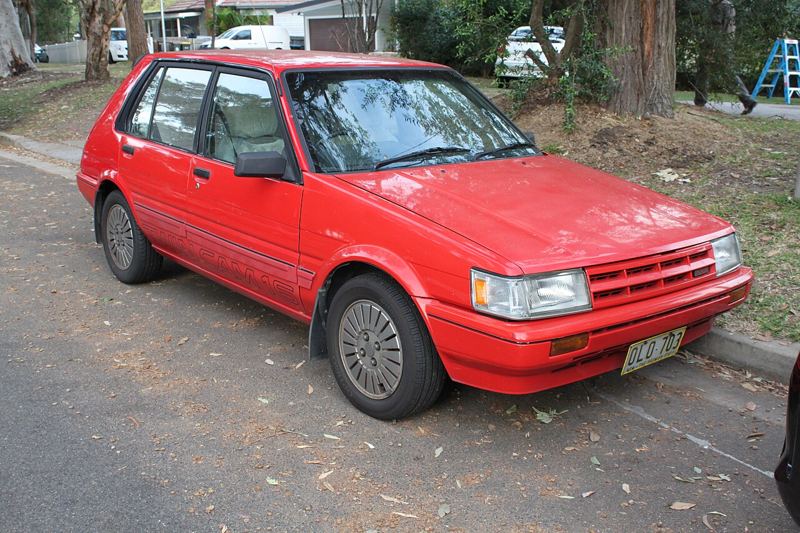
Photo: Jeremy from Sydney, Australia · CC BY 2.0 What changed. Launched in May 1983, it was the deepest change in the model's history: sedan, hatchback and liftback moved to front-wheel drive with a transverse engine, while the coupe kept rear-wheel drive. About 600 prototypes were built, 100 of them for crash tests, and more than 500 patents were filed. The AE86 "Hachi-Roku" coupe was the last rear-drive Corolla and is a drifting icon today.
The innovation. The generation introduced computer-aided design and the 1.6-liter, 16-valve, twin-cam 4A-GE, rated at 130 PS in Toyota’s historical account. In 1986 the NUMMI-built Corolla FX16 became the first Toyota-branded vehicle assembled in the United States.
If you buy one usedCertain 1984 Corollas have voltage-regulator campaign 83V133 and cruise-control-computer campaign 90V040; confirm actual applicability and completed work. For an AE86 or any modified car, verify chassis and engine identity, structural condition, workmanship and service records. Assess the actual vehicle and market price rather than assume a general affordability or modification-prevalence ranking. - Gen. 61987–1991
Crown-level quiet in a compact
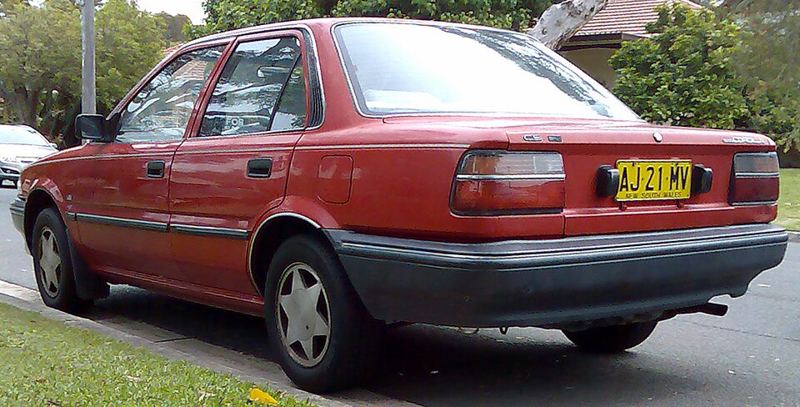
Photo: OSX · Public domain What changed. Launched in Japan in May 1987, it applied a front-drive-based architecture across the range, including four-wheel-drive derivatives. Development leader Akihiko Saito targeted Crown-like quietness and comfort, with more than 2,000 improvement proposals and over 100 parts manufacturers. Its 308,000 Japanese sales in 1990 set an annual record that lasted until Prius in 2010.
The innovation. It introduced the "High-Mecha Twin Cam" engines, with one camshaft belt-driven and the other driven by a scissor gear, which later became Toyota's mainstream engines. It also offered four-wheel drive on the sedan and wagon, and TEMS electronic suspension on upper grades.
If you buy one usedCheck installed accessories and replacement parts as well as the VIN. Campaign 16V396 explicitly includes certain 1989 Corollas with specified Southeast Toyota accessory seat heaters; the published remedy disconnects the heaters and refunds their purchase price. Equipment campaign 10E002 includes affected replacement front strut mounts for specified Corolla applications, including 1988–1991. Related Geo Prizms were built at NUMMI, but verify exact part numbers and configurations before assuming interchangeability. Confirm the actual engine and fuel system instead of using a global production-change date alone. - Gen. 71991–1995 (EE. UU. 1993–1997) · E100
A "mini Lexus" for the family
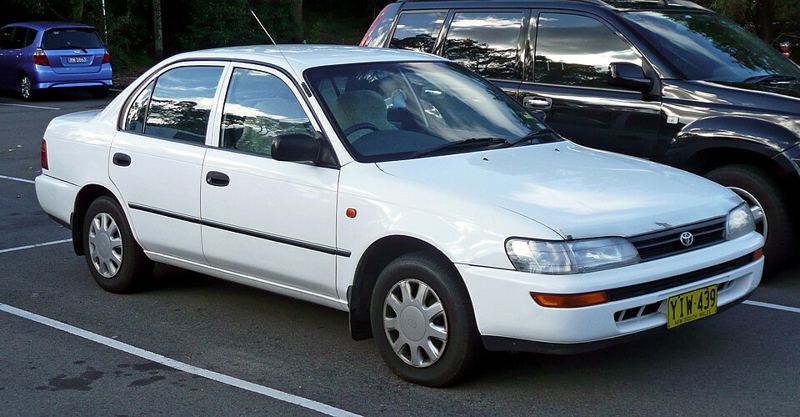
Photo: OSX · Public domain What changed. Launched in Japan in June 1991, it grew up to 100 mm in length and 35 mm in wheelbase, with curvier shapes and polycarbonate headlamps. Akihiko Saito called it "a mini Lexus": the front bulkhead layered steel and asphalt like the Lexus LS 400, and body cavities were foam-filled against noise. By then average production was 4,300 Corollas a day.
The innovation. Almost 90 percent of the bodyshell used galvanized steel, up 50 percent, while high-tensile steel represented 38 percent of body weight. Toyota’s UK history dates a standard driver airbag to September 1994 and describes ABS and rear discs on upper grades. The U.S. Corolla already had a standard driver airbag for MY1993.
If you buy one usedTwo selected campaigns include model year 1994: 94V220 for an unused wiring connector under the carpet exposed to salt-water intrusion, and 96V107 for airbag-sensor problems after console-area liquid spills. Their published remedies remove the unused connector or protect/replace the sensor as applicable. Verify the actual VIN, maintenance, corrosion and completed repairs rather than infer an individual car’s durability from its generation’s reputation. - Gen. 81995–2000 (EE. UU. 1998–2002)
A Corolla for every continent
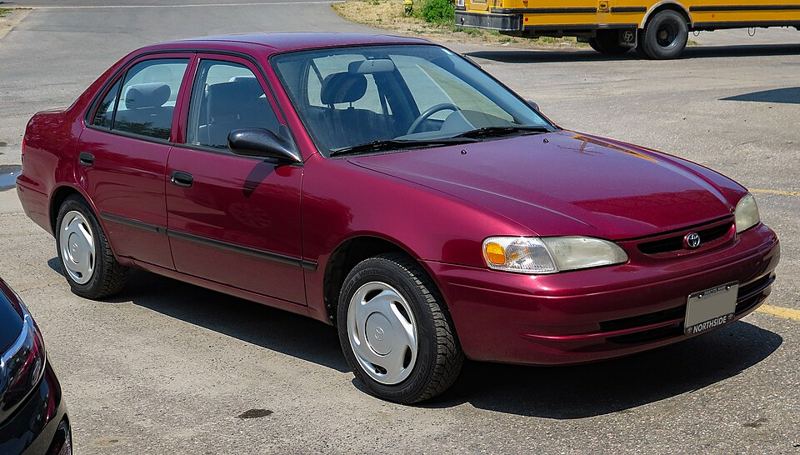
Photo: Elise240SX · CC BY-SA 4.0 What changed. Launched in Japan in May 1995 under development leader Takayasu Honda, it dropped the single "world car" idea: Asia, North America and Europe each got their own version. It returned to the original compact-sedan concept and lost about 50 kg despite reusing many parts. By June 1997 cumulative production stood at 23.5 million, and that year the Corolla became the best-selling nameplate in history.
The innovation. In 1999 production outside Japan passed Japanese production for the first time, spread across 16 countries and regions. In Europe, a three-door WRC-spec Corolla helped Toyota win the rally manufacturers' championship in November 1999.
If you buy one usedExact NHTSA Corolla queries on November 3, 2026 returned four replacement-equipment campaigns each for model years 1998 and 2001, with no Toyota-manufacturer campaign in those specific results. The 1998 results concern lamps; the 2001 results also include front strut mounts under 10E002. Inspect actual installed parts; a name/year lookup does not clear a particular car. The related Chevrolet Prizm was built at NUMMI; the factory’s original records identify the 1998 Geo-to-Chevrolet name change. Check condition and service history before comparing actual local prices. - Gen. 92000–2006 (EE. UU. 2003–2008) · E120
New platform and stability control
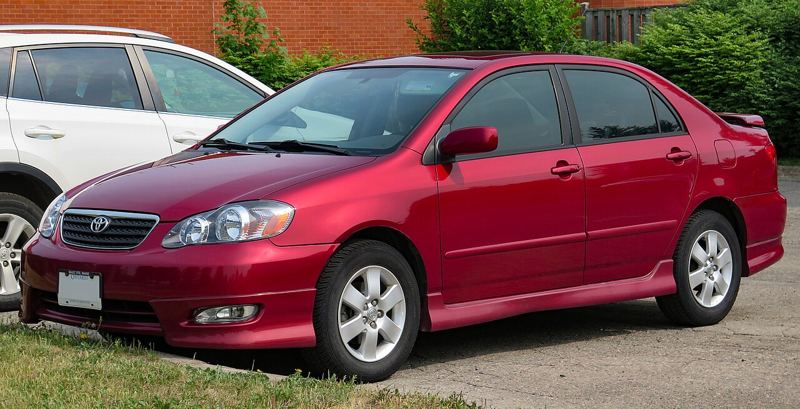
Photo: Elise240SX · CC BY-SA 4.0 What changed. Launched in Japan in August 2000 under chief engineer Takeshi Yoshida, it used a new platform; Toyota’s history describes a 135 mm longer wheelbase and a 90 mm higher roof for the program. It was the first Corolla with an exterior penned in Europe. The petrol engines described in that regional history all used VVT-i; diesel engines were also offered. Worldwide sales were about 1.39 million in 2005 and cumulative sales exceeded 31.6 million by June 2006.
The innovation. It was the first Corolla with Vehicle Stability Control (VSC) and traction control (TRC), plus electronic brake-force distribution and ISOFIX child-seat anchors. In the United States, the 2003 model also underpinned the Pontiac Vibe built at NUMMI.
If you buy one usedCheck the actual Takata-related campaign and previous repair history. Campaign 18V883 includes certain 2003–2005 Corolla inflators that can rupture, while 19V741 includes specified 2003–2013 cars with prior same-design replacement inflators. Campaign 19V627 addresses a different problem: certain replacement passenger-airbag assemblies on 2003–2008 cars may not unfold/inflate correctly in heat. Toyota’s January 25, 2024 DO NOT DRIVE notice includes certain unrepaired 2003–2004 Corolla and Corolla Matrix vehicles. Do not drive an affected vehicle until repaired; contact Toyota about free mobile-service or transportation options. Other selected campaigns include power-window glass bolts (08V162, 662,178 Corolla/Matrix/Vibe vehicles combined) and ECM manufacturing defects on certain 2005–2008 1ZZ-FE, two-wheel-drive cars (10V384). Confirm current VIN-specific eligibility and completed work. - Gen. 102006–2013 (EE. UU. 2009–2013)
Turin design and the year of the pedal
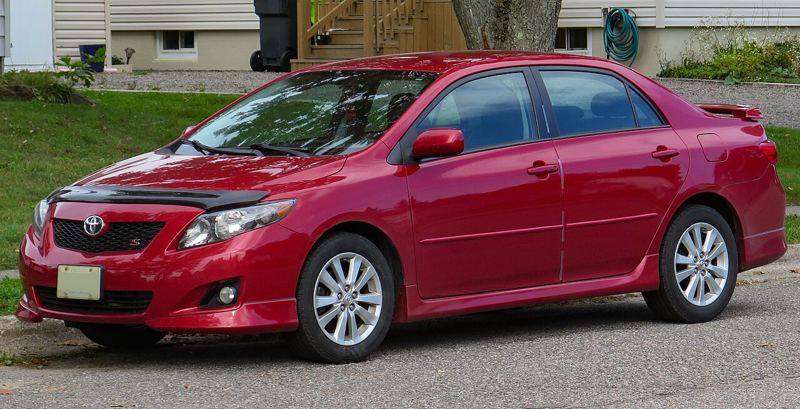
Photo: Elise240SX · CC BY-SA 4.0 What changed. The tenth generation reached Japan in October 2006 and the United States for the 2009 model year, with design developed alongside styling studios in Turin, Italy. It introduced the 1.8-liter 2ZR-FE engine with dual independent VVT-i (132 hp and 128 lb-ft, up to 35 mpg highway) and a 158 hp 2.4-liter exclusive to the XRS. For 2010, stability and traction control became standard on every US Corolla.
The innovation. In Japan, the Axio sedan offered Super CVT with a seven-speed sequential mode on the 1.8-liter engine and a rearview monitor standard across Axio grades. In the United States, VSC and traction control became standard for MY2010, completing the standard Star Safety System suite.
If you buy one usedCertain 2009–2010 Corollas have separate accelerator campaigns: 10V017 addresses sticking/slow-return pedals, and 10V023 addresses floor-mat entrapment. Also check spiral cable 14V168, 1.8-liter cold-state brake-vacuum campaign 09V338 and 2009–2011 window-switch campaign 15V689. Takata campaigns 16V340, 17V006 and 18V024 have specific year/geography cohorts; 19V741 addresses specified previously replaced inflators. Certain 2011–2013 vehicles are included in ECU campaign 20V024, whose remedy inspects the ECU and installs a noise filter where necessary. The published remedies are free; confirm every applicable current campaign and repair rather than rely solely on an earlier invoice. - Gen. 112012–2019 (EE. UU. 2014–2019)
More rear legroom and LED headlights for all
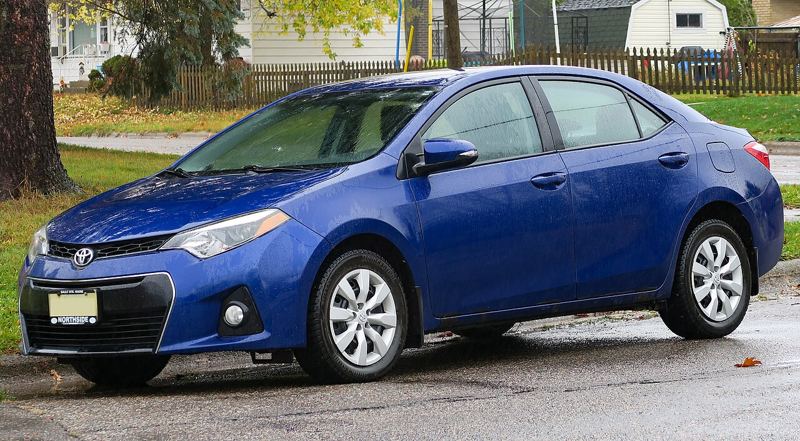
Photo: Elise240SX · CC BY-SA 4.0 What changed. Revealed in the United States on June 6, 2013 as the "most surprising and capable" Corolla, the eleventh generation stretched the wheelbase 100 mm (to 106.3 inches) and the length 3.9 inches, with much more rear legroom. The 1.8-liter 2ZR-FE made 132 hp, and the new LE Eco with Valvematic rose to 140 hp and 42 mpg highway. It went on sale in September 2013 from $16,800.
The innovation. It was the first compact sedan with standard LED headlamps on every grade, and it introduced the CVTi-S transmission with simulated shift points. The first Corolla of this generation rolled out of the Blue Springs, Mississippi plant on September 7, 2013; in Japan, from 2013, the range added hybrid versions.
If you buy one usedCampaign 20V024 includes certain 2011–2019 Corollas whose airbag ECU may fail during some crashes and disable airbags or pretensioners; dealers inspect and install a noise filter where necessary. Certain 2014 cars also have windshield-wiper-switch campaign 13V505. These are selected examples, not a complete future inventory. Verify the VIN and service records, and inspect the actual car’s condition. - Gen. 122018–present (EE. UU. 2020–present) · E210
TNGA platform and the first US hybrid
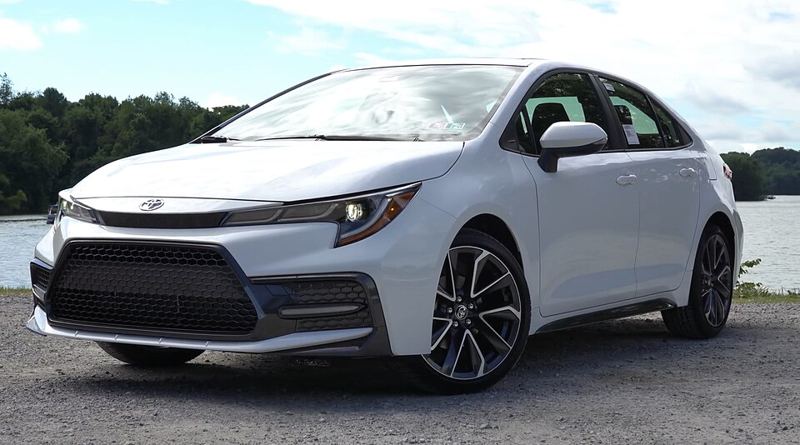
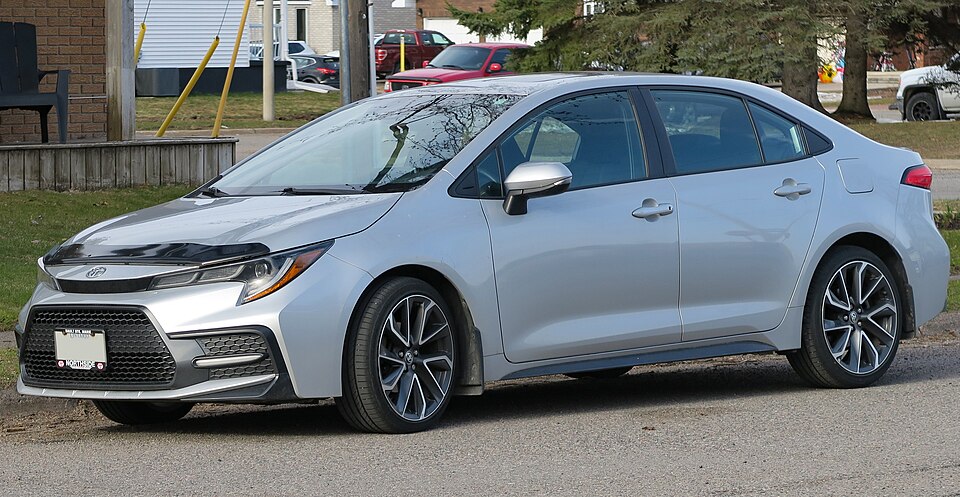
Photo: Gold Pony · CC BY-SA 4.0 What changed. Toyota publicly revealed the 2020 sedan in Carmel on November 15, 2018; the February 26, 2019 Savannah release provided later launch and technical details. U.S. sales began in March 2019. The TNGA platform brought a multi-link rear suspension in place of the prior torsion beam. SE and XSE used a 169 hp, 151 lb-ft 2.0-liter Dynamic Force engine, while L, LE and XLE retained a 1.8-liter. The first twelfth-generation Corolla left Toyota Mississippi on March 18, 2019 after a $170 million investment.
The innovation. It was the first Corolla Hybrid sold in the United States: a 1.8-liter with two electric motors, 121 combined hp and an EPA-rated 52 mpg combined. Toyota Safety Sense 2.0 became standard on every 2020 sedan grade.
If you buy one usedSelected campaigns to check by VIN include 20V682 for certain 2020 fuel pumps, 19V877 for specified 2020 Corolla/Hybrid rear seat belts, 23V865 for certain 2020–2021 occupant-classification sensors, and 23V480 for certain 2023 driver-airbag spiral cables. Campaign 25V040 requires a new inspection and repair where needed on vehicles potentially repaired incorrectly under 23V480. Certain 2023–2024 Corolla/Hybrid vehicles also have intermediate steering-shaft campaign 24V878. Published remedies are free; confirm the actual equipment, eligibility and completed work with Toyota.
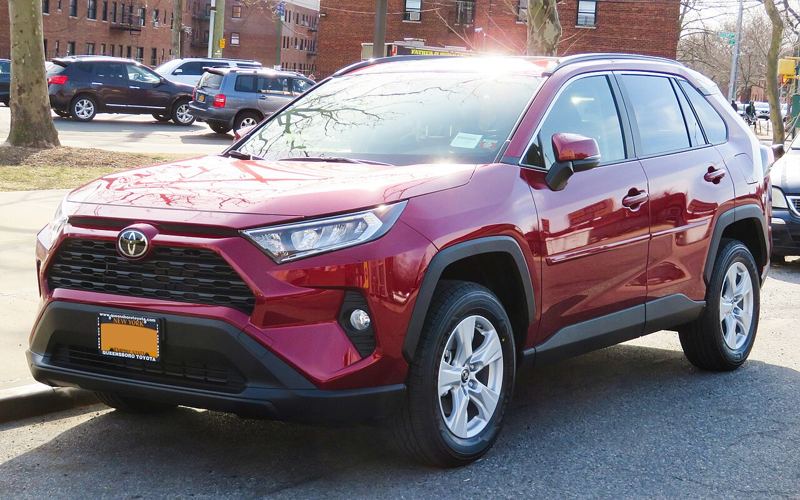 Toyota RAV41994–present (US from 1996)
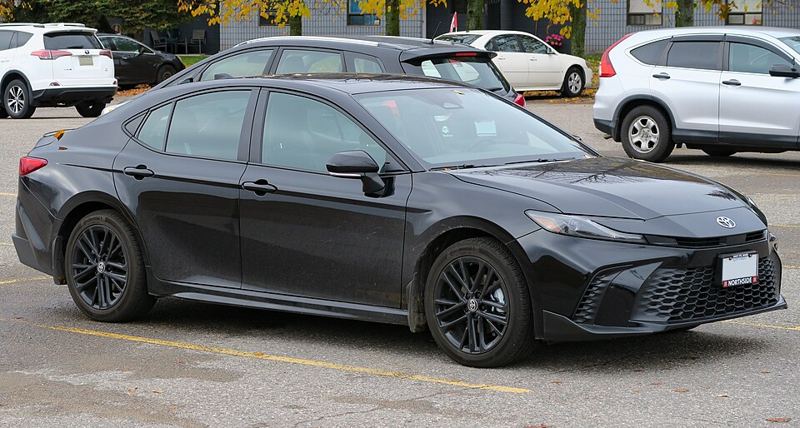 Toyota Camry1982–present
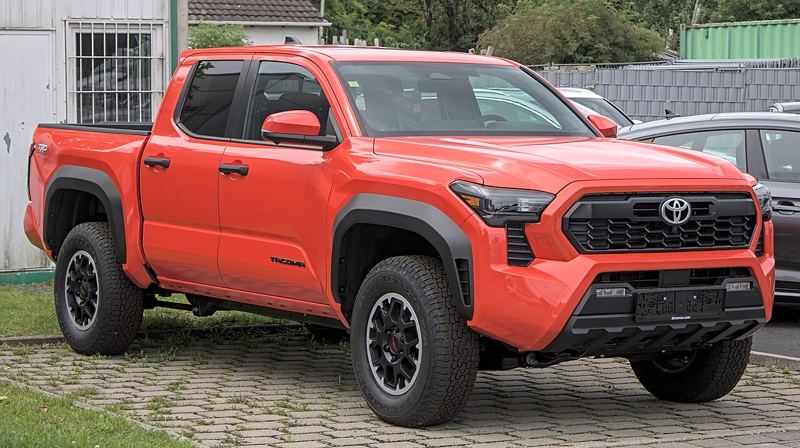 Toyota Tacoma1995–present
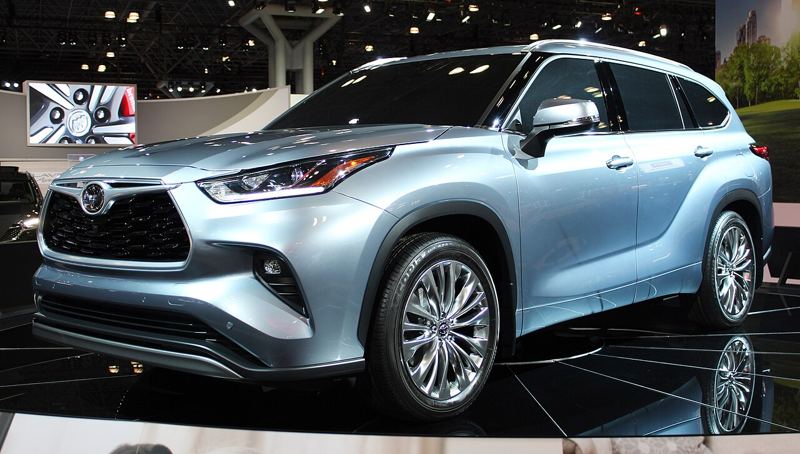 Toyota Highlander2001–present
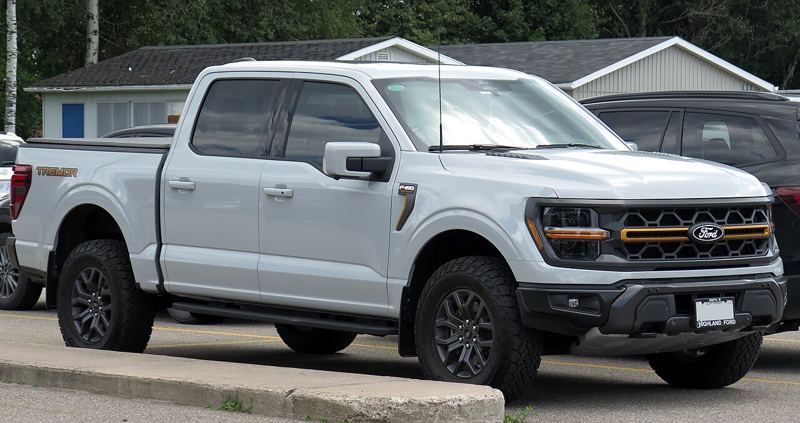 Ford F-Series (F-150)1948–present
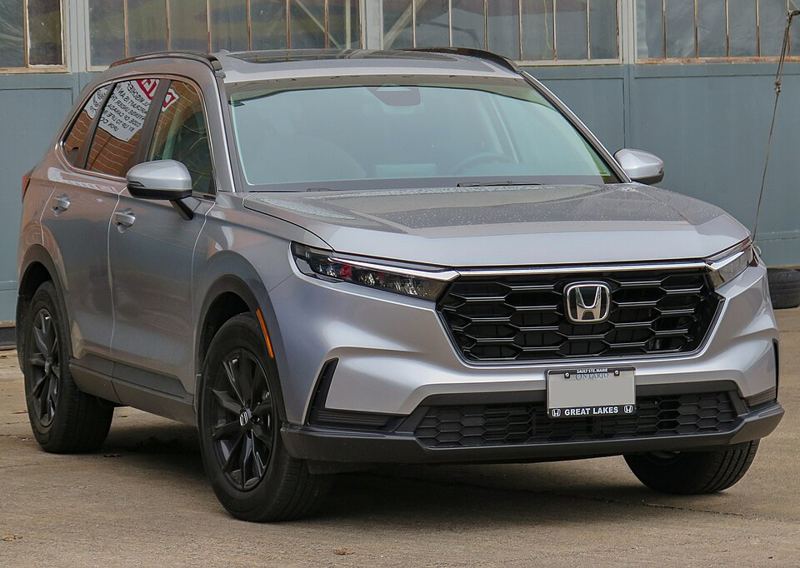 Honda CR-V1995–present
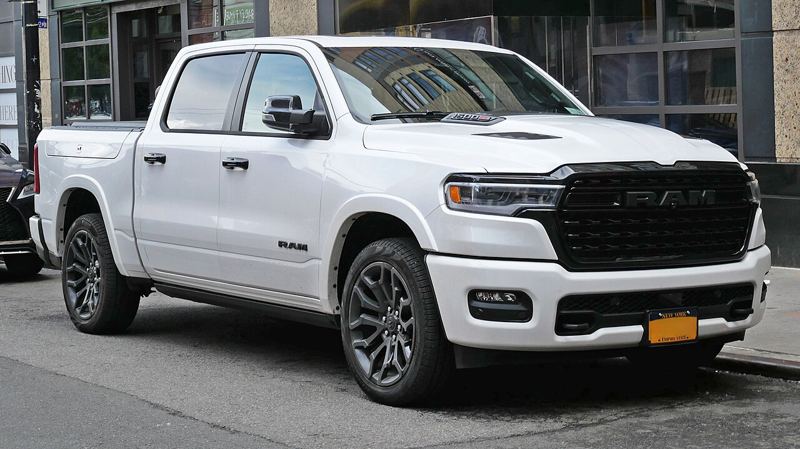 Ram 15001981–present
 Tesla Model Y2020–present
 Chevrolet Silverado1999–present


