
Hyundai Elantra
Compact sedan · 1990–present. 136,698 units sold in the US in 2024
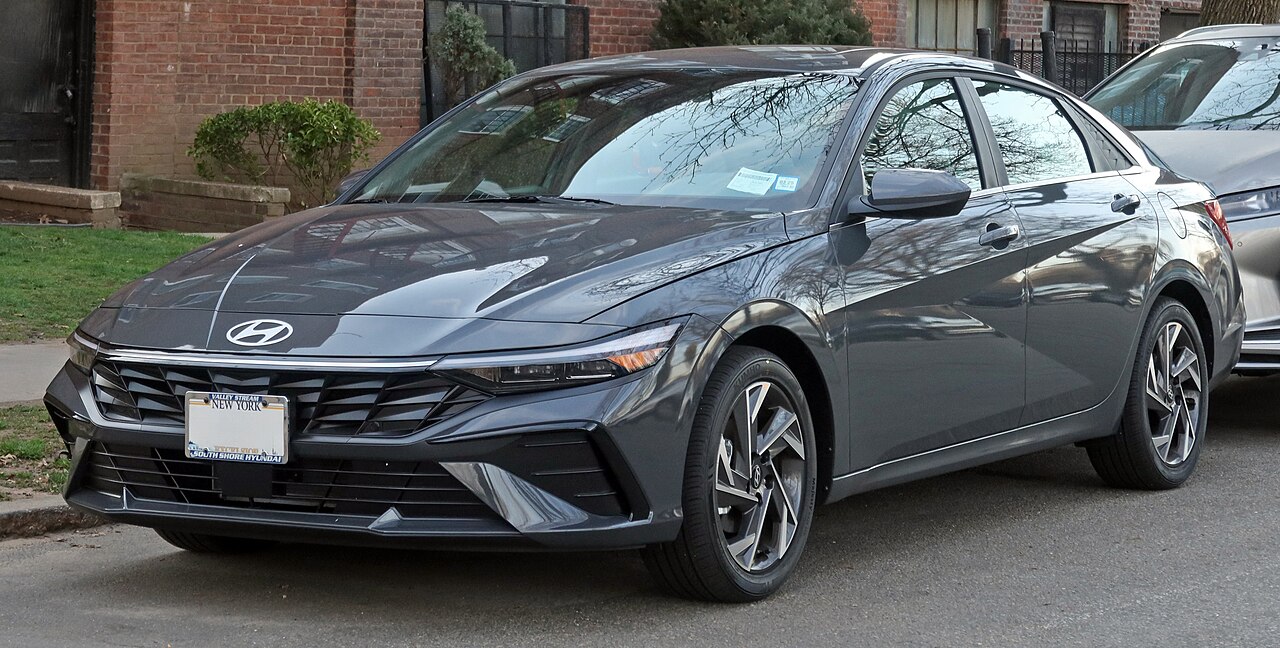
How it began
Hyundai Motor Company developed the Elantra in South Korea as a pioneer of the country’s compact-sedan category, using Mitsubishi-designed engine technology. No individual original chief engineer was identified in the official records reviewed. Later credits are clearer: John Krafcik presented the 2007 car as Hyundai Motor America’s product-development vice president. For the fifth generation, an original DMI case based on Hyundai interviews describes joint Namyang/Irvine design work integrated by Koo Bon-Jun, with Kim In-Seop credited for the interior. Luc Donckerwolke and Brian Smith spoke at the 2021 model’s premiere.
The Elantra originated and was first built in South Korea. Alabama production began at Montgomery in November 2010 alongside Sonata. The original 2021 program named both Ulsan and Alabama. HMMA’s own October 2024 fact sheet records its Elantra production period as November 2010–May 2023; its current assembly overview lists SUVs and Santa Cruz. That historical Alabama credit should not be read as current Elantra assembly there.
It debuted in Korea in October 1990. Hyundai Motor America’s brand history reports U.S. introduction in August 1991 as a 1992 model. The global start, U.S. calendar arrival and first U.S. model year are different dates.
Elantra combines French élan—spirit or style—with the root of English transport, as described in the original DMI case developed with Hyundai participants. Hyundai’s European history confirms that it initially used the Lantra name in Europe. The complete Australian/Lotus naming-dispute explanation remains pending a primary record. The Avante name began with the second generation in Korea in 1995.
In 1990 Korea there were only small, midsize and large cars. Hyundai created a new segment: a compact with the low cost of a small car and the cabin space of a midsize one, aimed at mass buyers. In the United States it filled the size and price gap between the budget Excel and the Sonata.
Generation by generation
- Gen. 11992–1995 · J1
Hyundai’s Korean compact-sedan pioneer
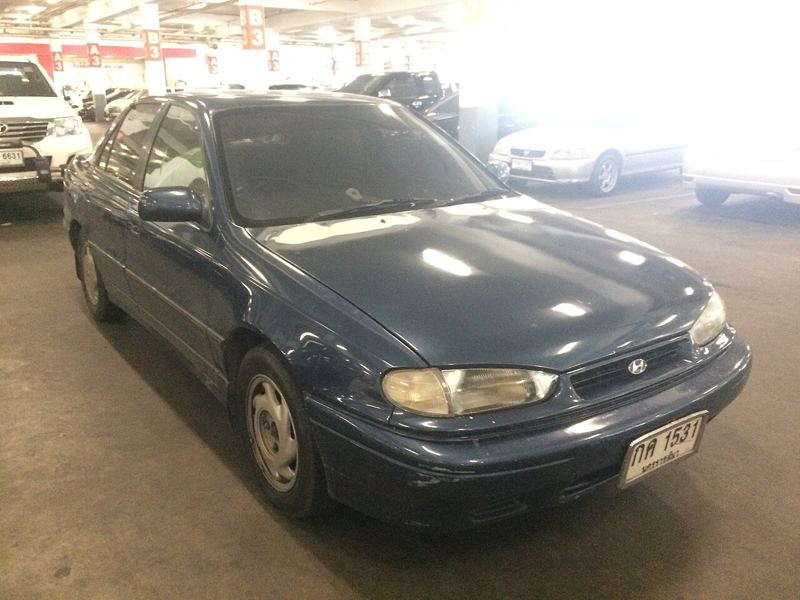
Photo: Jirapat Chroenkeskij · CC0 What changed. A new U.S. offering between Excel and Sonata, sold as a four-door sedan. The original manual test car had a 1,596 cc twin-cam engine rated at 113 hp. A driver airbag was added for model year 1994, with ABS available as an option. More precise early automatic and 1.8-liter introduction details remain in the evidence gaps.
The innovation. Hyundai’s original Korean specification gives the 1.6-liter 126 PS at 6,000 rpm, approximately 124 mechanical hp. This Korean metric-horsepower rating differs from U.S. specifications. The claim of being the first Korean compact with driver airbag and ABS remains unverified as a market-wide first.
If you buy one usedNHTSA lists for the 1994 model a crank angle sensor with an out-of-spec coating that could stall the engine when hot (94V090), and for 1994–1995 an improperly assembled driver airbag that lit the warning light (95V101). Consumer Guide documents automatic transmissions that slip or won't engage fourth gear and hard starting from a cracked in-tank fuel line on 1992–1995 cars. Today it is a collector car. - Gen. 21996–2000 · J2
Bigger, quieter and with a wagon
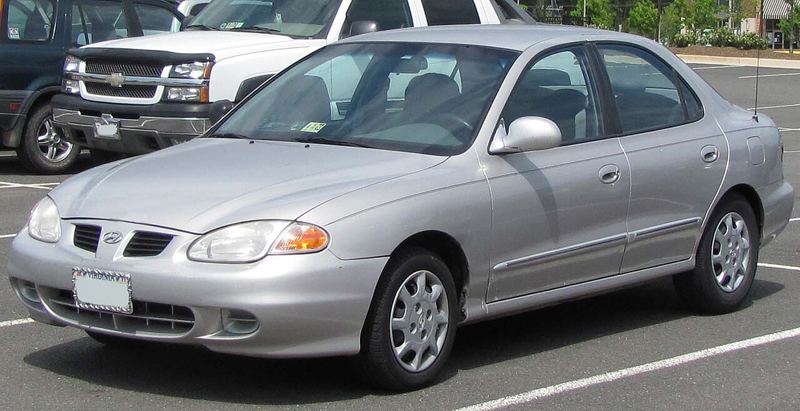
Photo: IFCAR · Public domain What changed. Wheelbase grew about two inches to 100.4 inches, with better room and refinement. A wagon with four passenger doors and a rear liftgate joined the sedan for model year 1996. The original 1.8-liter was advertised at 130 hp; Hyundai’s 1999 announcement introduced a 2.0-liter advertised at 140 hp. These are period published ratings. The Korean version introduced the Avante name.
The innovation. Dual front airbags were standard in the U.S. sedan and wagon range. The wagon’s folding rear seat created a flat load area; the precise 63-cubic-foot maximum remains pending an original specification with its measurement conditions.
If you buy one usedNHTSA recalls: wiper motor with contaminated contacts (97V026, 1996–1997), an evaporative emissions system that could distort and crack the fuel tank (00V095, 1996–1997), leaking automatic transmission solenoid valve seals (99V178, 1999) and wiring that caused low-speed stalling (00V259, 1999–2000). Consumer Guide notes timing belt idler pulley noise on 1999–2000 cars. - Gen. 32001–2006 · XD
Standard side airbags and the GT hatchback
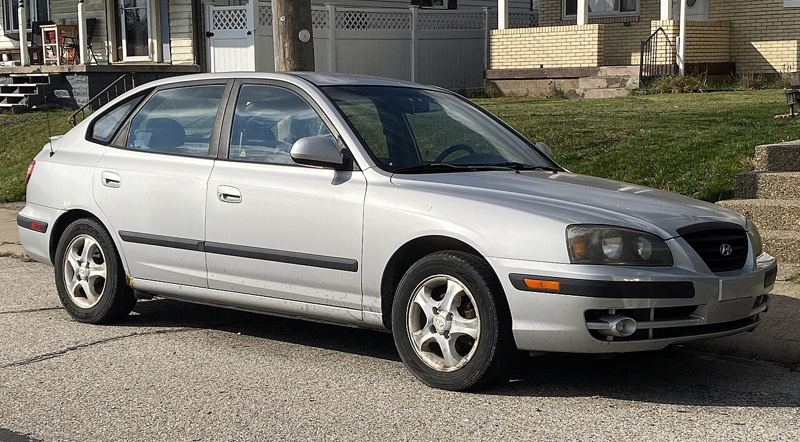
Photo: Cutlass · CC0 What changed. The wheelbase grew 2.3 inches and the body was longer. The U.S. lineup dropped the wagon and added the five-door GT during model year 2001. Original 2.0-liter output was advertised as 140 hp and later corrected; by 2004 Hyundai specified 138 hp for ULEV and 132 hp for PZEV versions. Gas shocks, 15-inch wheels and standard front side airbags improved the equipment. The period 10-year/100,000-mile powertrain coverage applied to original owners and qualifying immediate family, with different coverage after resale.
The innovation. Standard front side airbags, together with pretensioners and force limiters on the front seat belts, uncommon in an affordable 2001 compact.
If you buy one usedThe most serious recall is 09V125: 160,904 vehicles in total, including certain 2001–2003 Elantras and 2003 Tiburons in road-salt states, because the front lower control arms could corrode and fracture. Also: rear brake tubes rubbing the steering gearbox mounting brackets (03V257 and 03V496, 2001–2003), a fuel tank valve that might not close in a rollover (04V178 and 04V369, 2002–2003) and inner steering ball joints with threads that could crack (05V187, 2005). Consumer Guide advises checking the valves every 60,000 miles and adjusting them as needed. - Gen. 42007–2010 · HD
A compact the EPA calls midsize
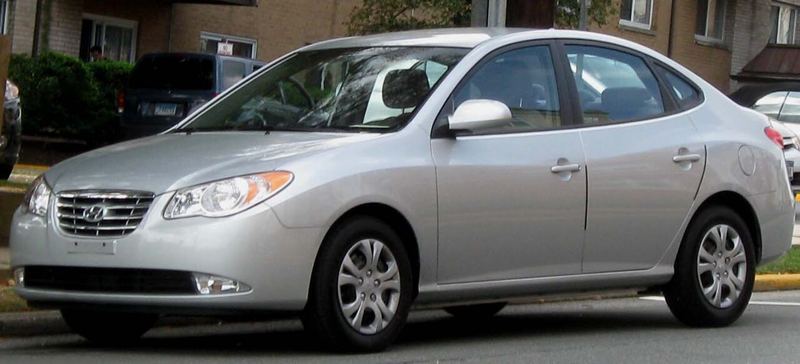
Photo: IFCAR · Public domain What changed. The U.S. 2007 car premiered in New York on April 13, 2006. It was 2.2 inches taller and two inches wider, following the design direction introduced by Santa Fe. Its 112.1 cubic feet of combined passenger/trunk volume placed it in the EPA midsize interior class. The 138-hp 2.0-liter carried period government ratings of 28 city/36 highway mpg. Launch base MSRP was $13,395, or $13,995 including the $600 freight charge.
The innovation. Six airbags, ABS brakes and active front head restraints, all standard. Hyundai boasted that it had more interior room than an Acura TL.
If you buy one usedThe key recall is 20V061: on 2007–2010 Elantras and 2009–2011 Elantra Tourings, moisture can enter the ABS module and short it, with a risk of engine-compartment fire even with the car off; the fix is a relay in the junction box. Also: electric power steering that could lose assist (15V100, 2008–2010), a passenger-seat weight sensor that could deploy the airbag when it should not (11V143, 2007–2009), the fuel pump on 65,000 2008 cars with the 2.0 engine (08V429) and the stop lamp switch (13V113). - Gen. 52011–2016 · MD
Fluidic Sculpture and 2012 Car of the Year
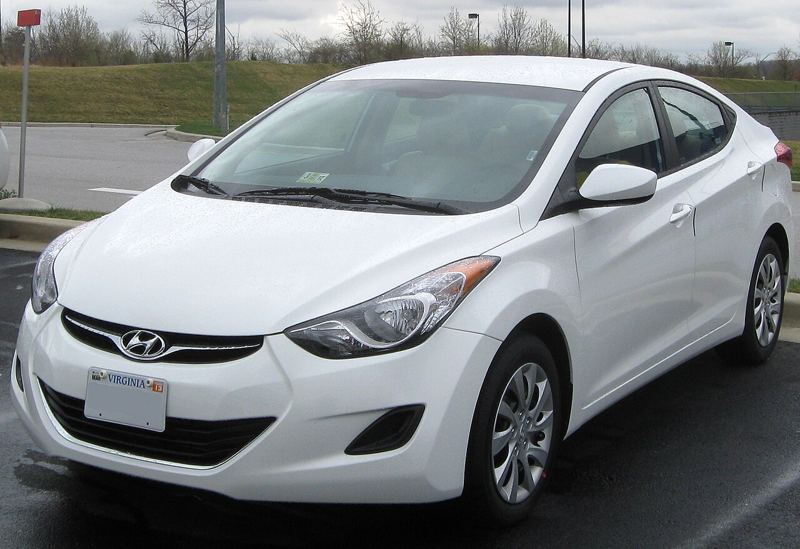
Photo: IFCAR · Public domain What changed. The U.S. model debuted in Los Angeles on November 18, 2010 with Fluidic Sculpture styling and a 0.28 drag coefficient; Alabama production began that November. The Nu 1.8-liter made 148 hp in ULEV form and 145 hp in PZEV form, paired with six-speed manual or automatic transmissions. Initial 29 city/40 highway mpg labels were revised in November 2012 to 28/38 for 2011–2013 Elantra 1.8-liter manual/automatic models. Base MSRP was $14,830 before freight, and it won 2012 North American Car of the Year.
The innovation. The aluminum-block Nu engine assembly weighed 74 pounds less than the outgoing 2.0-liter Beta. Hyundai compared the new six-speed automatic with its global five-speed, reporting 62 fewer parts; that comparator was not the outgoing Elantra automatic. Heated rear seats were available and described by Hyundai as a segment first.
If you buy one usedCheck two serious recalls. 23V651 (2011–2015): the ABS module can leak brake fluid internally and cause a fire, so NHTSA says to park outside and away from structures until repaired. 26V307 (2015–2016, May 2026): the driver airbag inflator can rupture and throw metal fragments; the final remedy was expected in August 2026. Also: a headliner bracket that can shift when the curtain airbag deploys (13V115, 2011–2013), a stability-control sensor that applied brakes unexpectedly (15V871, 2011–2012) and the brake pedal stopper pad (17V769, 2013–2014). - Gen. 62017–2020 · AD
More high-strength steel and an Eco turbo
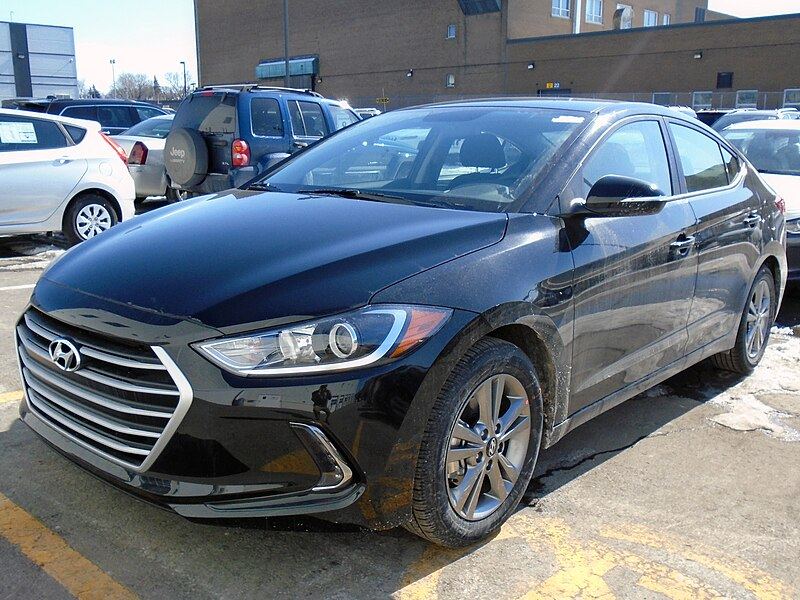
Photo: Whydoesitfeelsogood · CC BY-SA 4.0 What changed. It premiered in Los Angeles in November 2015; SE and Limited reached U.S. dealers in January 2016 as 2017 models, assembled in Montgomery and Ulsan. The 147-hp 2.0-liter offered six-speed manual or automatic transmissions. The 33-mpg combined rating applied to the SE automatic; the $17,150 base MSRP before $835 freight bought the SE manual, $100 less than its predecessor.
The innovation. Advanced-high-strength-steel share rose from 21% to 53%, an increase of 32 percentage points, with greater rigidity and lower body weight. Eco added a 128-hp 1.4-liter turbo and seven-speed dual-clutch transmission. Hyundai initially projected 35 mpg combined and its May 2016 release confirmed an EPA rating of 32 city/40 highway/35 combined.
If you buy one usedFor 2019–2020 cars with the 2.0 Nu engine there is recall 21V301: the piston oil rings may not have been properly heat-treated, risking engine damage, stalling and oil leaking onto the exhaust; the dealer inspects and, if needed, replaces the engine, and installs software that listens for piston ring noise. For 2017: the driver airbag inflator seal (16V956), a brake booster that could fail (17V063) and damaged electric power steering (17V213). - Gen. 72021–2026 · CN7
Parametric Dynamics, the first hybrid and the Elantra N
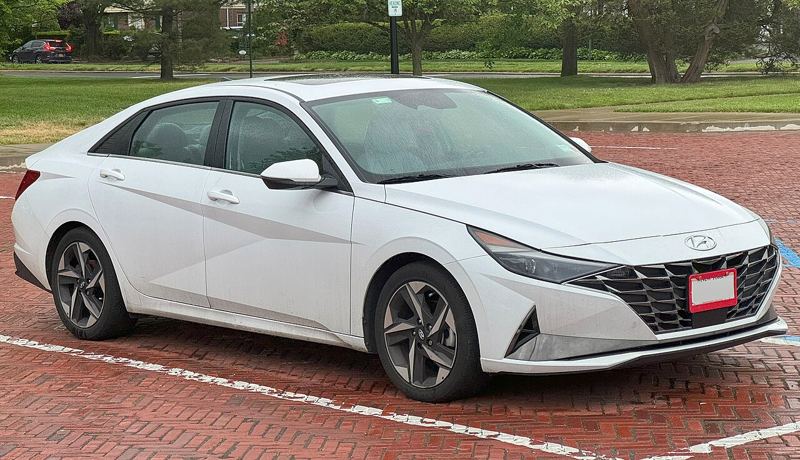
Photo: Mr.choppers · CC BY-SA 3.0 What changed. It premiered in Hollywood on March 17, 2020 with Parametric Dynamics design, a four-door-coupe look: 2.2 inches longer, 1 inch wider and 0.8 inch lower, on a new, lighter platform. The Atkinson-cycle 2.0 makes 147 hp with an IVT transmission. It was 2021 North American Car of the Year, and the high-performance Elantra N arrived in 2021.
The innovation. The first U.S. Elantra Hybrid used a 1.6-liter Atkinson engine, 32-kW electric motor and 1.32-kWh battery beneath the rear seats, producing 139 hp of total system output. At the March 2020 premiere Hyundai projected more than 50 mpg combined; final ratings depend on trim. Optional compatible-phone Digital Key and wireless Apple CarPlay/Android Auto also debuted, with equipment varying by display and trim.
If you buy one usedNHTSA lists for 2021–2022 front seat belt pretensioners that could explode on deployment (22V354, hybrid included), plus other seat belt recalls (22V123, 22V218) and one for the rearview camera (24V879). Later: a driver airbag emblem that could detach (22V632, 2022 Elantra N and 2022–2023 Elantra), an Idle Stop & Go oil pump controller that could overheat (23V526, 2023) and a shorting EGR valve that could cut drive power (24V308, 2024). For 2026 there are recalls for B-pillar impact sensors (26V254), front strut fasteners (26V692) and wheel lug nuts (26V693). Under its 2025 award criteria, IIHS named 2025–2026 cars built after October 2024 a Top Safety Pick+. - Gen. 82026 (global) · CN8
Eighth generation revealed in Korea; U.S. details pending
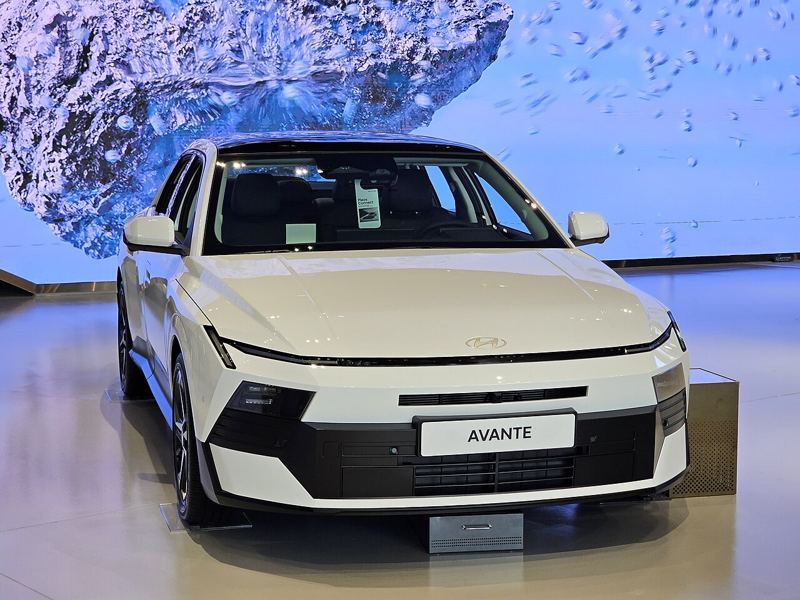
Photo: Damian B Oh · CC BY-SA 4.0 What changed. Hyundai unveiled the all-new eighth-generation Avante in Busan on June 26, 2026. Korean specifications give a 30-mm increase in both width and wheelbase, a 149-PS 2.0-liter gasoline engine (about 147 hp), and a 157-PS 1.6-liter hybrid system (about 155 hp). These Korean figures do not confirm U.S. carryover specifications, model year or arrival. The new-hybrid two-motor assertion remains unverified.
The innovation. The Korean hybrid introduces Smart Regenerative Braking 3.0, using traffic/navigation information to adjust regeneration and assist deceleration to a stop. V2L was not established for this model in the original release, engineering account or current brochure. Hyundai has demonstrated a new prototype N engine in race cars, but the exact displacement and production specification of the next road Elantra N remain unconfirmed in the primary records reviewed.
If you buy one usedBefore buying the redesigned Elantra, confirm its U.S. model year and specifications with Hyundai, and check current campaigns by VIN at NHTSA.
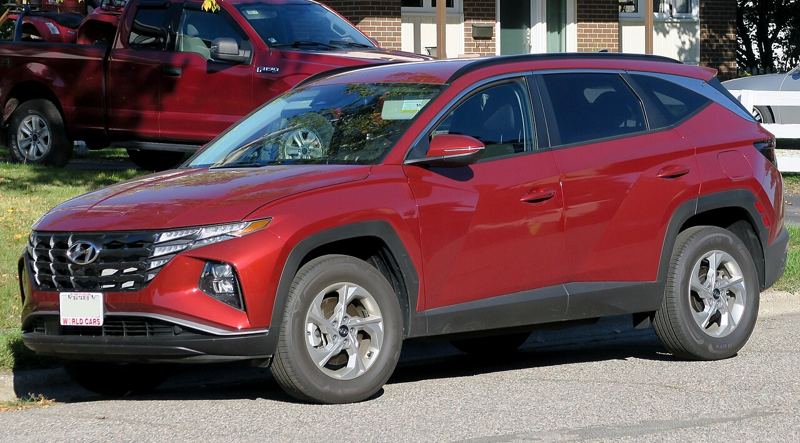 Hyundai Tucson2004–present
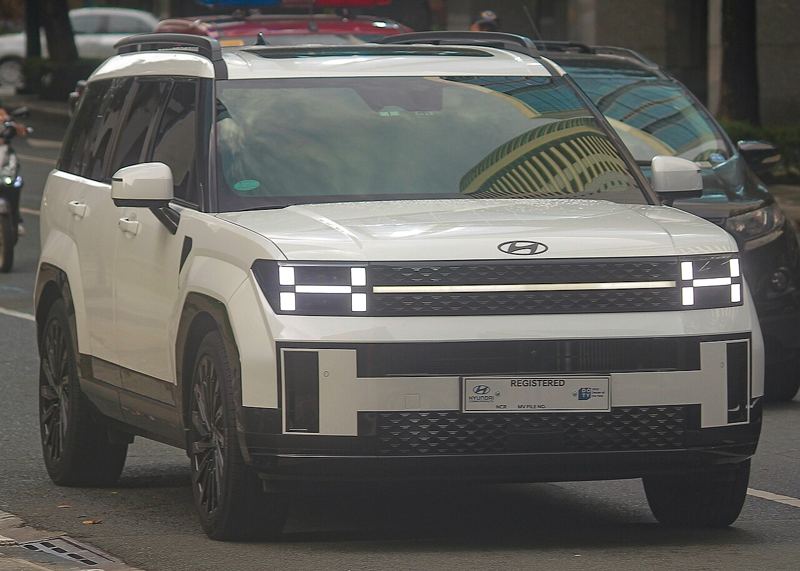 Hyundai Santa Fe2001–present
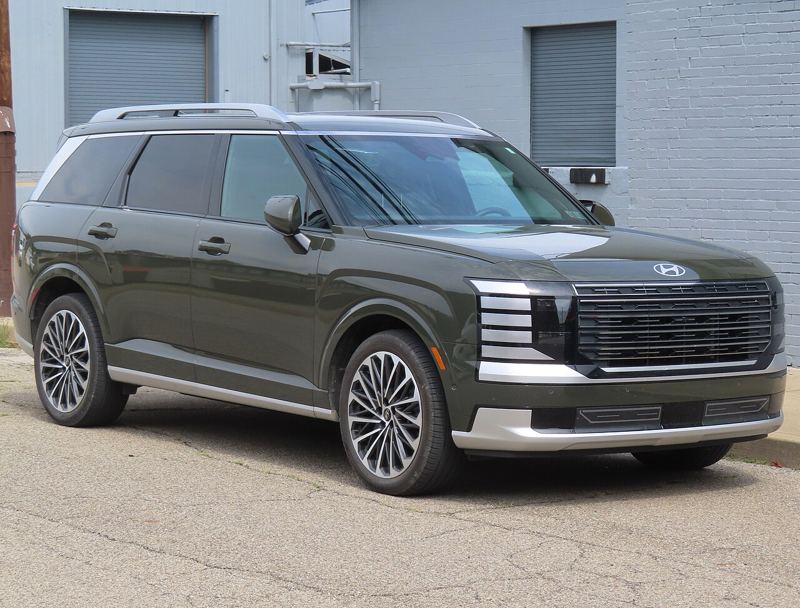 Hyundai Palisade2020–present
 Hyundai Kona2018–present
 Ford F-Series (F-150)1948–present
 Toyota RAV41994–present (US from 1996)
 Honda CR-V1995–present
 Ram 15001981–present
 Tesla Model Y2020–present


